
Reviewed · WWII HISTORY TOURS
Gdansk: Museum of World War II – True Story of a Living Hell
World War II can feel like a list of dates until you see it staged as a lived experience. In Gdansk, this museum turns the story into a guided route that connects big events with personal survival, and it does it with objects you can actually point at. I especially like the way the exhibition builds from political roots to what happened on the ground, and I also like the practical support that helps you keep your footing in a heavy topic, like the option for headphones and a clear layout.
Two things I love here are the 20-room route that keeps you moving through the war in a structured way, and the chance to focus on Danzig and the region, not just the usual Western Europe storyline. The one drawback to consider is the museum asks for stamina: even with a guide, you will want at least three hours and you may feel the repetition of videos and scenes if you prefer quicker stops.
Key highlights you should know before you go

- A 20-room layout along a long corridor axis, mixing major events with everyday life displays
- Context for Danzig’s wartime position, including how World War I and the Treaty of Versailles shaped the city
- Memorable artifacts, from Stalin’s pipe to a Sherman tank and an Enigma machine
- Audio support that helps you follow where you are, plus video and film in many sections
- Practical comfort options, including a cloakroom and a cafe
- Built for real access, with lifts that take you down from the street-level entrance to lower levels
A WW2 museum in Gdansk that feels like a story you can navigate
This Museum of World War II in Gdansk is interesting because it does not treat the war like a timeline you skim past. Instead, you move through rooms that feel designed to explain cause and effect, then slow down when personal life takes over. It is heavy, yes, but it is also carefully organized, which makes the experience easier to process than a random wander through a static gallery.
The layout matters. The main exhibition runs through 20 rooms positioned on either side of a long corridor axis. That corridor is not just a hallway. It carries displays of everyday life during the war, so you can see how ordinary routines were bent, interrupted, or erased. You start with a room anchored by a semi-circular screen that shows the rise of totalitarian regimes across Europe, which sets you up to understand the rest without needing outside background.
One detail I found especially useful is how the museum covers the war at multiple levels. It connects geopolitics and military strategy to personal experiences. You do not just learn what happened. You also see why it happened to real people, in a city and region that were caught between empires and ideologies.
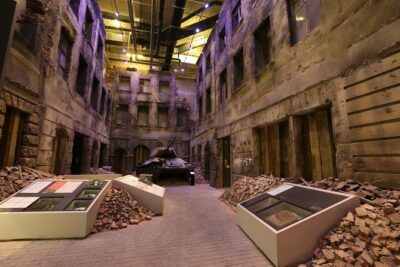
And yes, the objects help. You will see items linked to major themes of the era, including Stalin’s pipe, a Sherman tank, and an Enigma machine. Whether you are a gadget person or a history person, these artifacts give you something solid to hold onto when the information gets emotionally intense.
More WWII History Tours in Gdansk:
- Museum of the Second World War Gdansk Private Tour & Tickets
★ 5.0 · 24 reviews - Gdansk Private WWII Tour with Museum of the Second World War
★ 4.9 · 22 reviews - Private WW2 Tour of Westerplatte,Gdansk and Stutthof Including Lunch
★ 5.0 · 12 reviews
Meeting at Plac Władysława Bartoszewskiego, and how the private tour works
The tour starts where you want to be: right at the Museum of the Second World War, at Plac Władysława Bartoszewskiego 1, 80-862 Gdańsk. You meet the guide in front of the museum, then you are quickly in the rhythm of the visit.
This is a private experience, meaning it is only your group. That small detail makes a difference, because you can ask questions and pace yourself without getting swept along by a larger crowd. The guide is described as a licensed, five-star professional fluent in your selected language, and in this case the tour is offered in English.
You should also know the tour does not include hotel pickup by default. There is an option to arrange transportation for an additional fee of 20 Euro if you request it.
Two practical perks are baked in:
- Your ticket is included in the tour, so you are not juggling separate museum purchases.
- You get a mobile ticket, which saves time on arrival.
It is also noted that the museum is near public transportation, which helps if you are building a day that includes other Gdansk sights.
Step-by-step through the exhibition, from Danzig’s roots to daily survival
The visit has two parts in practice. First, you meet, get settled, and then you move into the main exhibition for about 2 hours 50 minutes. That main time is where the museum’s storytelling style shows itself.
Start with the war’s setup, not just the outcome
You begin with background that explains how the conflict grew. The museum makes a point of connecting the war to the political situation in Poland and the wider region. For the city of Danzig, it highlights a specific thread: the end of World War I and the Treaty of Versailles left the city in a kind of political limbo. It had been governed by Germany for about 146 years after the partitions of Poland, and now it was stuck between competing realities.
That local framing is a big deal for you if you are visiting Gdansk because it turns the museum from a general WWII stop into a sharper understanding of why this place mattered. You are not just learning about Germany and Russia. You are learning about the experience of being located where borders were being redrawn and power was being contested.
More Museums in Gdansk:
- Tower of Secrets (Wax Figure Museum, Horror House and much More)
★ 4.0 · 30 reviews - Gdansk: Private Communism Tour with Solidarity Center Museum
★ 5.0 · 28 reviews - Auschwitz-Birkenau Museum and Memorial Guided Tour from Krakow
★ 4.5 · 1,510 reviews - Warsaw: POLIN Museum of the History of Polish Jews Ticket
★ 4.7 · 1,142 reviews
Then follow the war’s scope: political, military, personal
As you continue, the museum stays organized around the full scope of WWII. There is military history, but it does not live alone. It is paired with geopolitical explanations, and it is paired again with personal fate. You will notice that the museum does not only list major events. It presents the war as something that hit multiple layers at once.
This is where the corridor layout helps again. The long axis is meant to guide you through the story, while the rooms on both sides keep you from feeling like you are missing sections. If you like a clear route, this design makes your visit less chaotic.
Objects and rooms give you anchors
The museum’s use of artifacts is more than decoration. Seeing real technology and real things from the era gives your brain reference points. If you have ever found it hard to picture war, these anchors help. The Enigma machine, for instance, signals the intelligence and code-breaking side without making you rely only on descriptions. A tank like a Sherman brings you back to the mechanical scale of conflict. Items tied to political leadership, like Stalin’s pipe, ground the ideological layer in a tangible detail.
Personal stories alternate with larger events
The way the story is structured also helps you keep empathy from getting lost in the facts. In the reviews, people highlight how the museum shifts between individual fates and major events. That rhythm is a practical tool. If you are emotionally overwhelmed, the museum gives you a pause through a different angle, then returns you to the bigger picture.
Audio, video loops, lifts, and the practical stuff that keeps you comfortable
The museum works hard to help you follow along. You will likely use the audio headset, and that is a smart move. One strong tip from the experience is that the audio guide is designed to match where you are, basically helping you identify the right places as you move through the route.
Even if you like reading labels, audio can reduce the cognitive load. You can listen while you look, instead of choosing one channel and losing the other. In reviews, people call out that the audio headset proved invaluable, and that it was easy to use while still allowing time to read displays and inspect artifacts.
Headphones are available on site
There are headphones available at the desk, and the museum setup supports translation. If you are planning to use English audio, give yourself time to pick it up and do a quick test before the route gets going.
Video clips are powerful, but plan for repetition
This museum includes lots of film, photos, and video clips. They can run in loops. That does not mean it is poorly done. It just means you should expect some overlap if you stop for extra reading or linger longer than average in one room.
A balanced approach works best:
- If you see a key scene, pause and watch.
- If you notice you already watched the video in another section, keep moving and spend your time on the objects and labels that are new to you.
Accessibility basics: lifts and a street-level entrance
One practical point that matters for comfort: access includes lifts. The entrance is at street level, and the route can take you down to lower levels for access. If stairs slow you down, plan to use the lifts and not feel rushed.
Cloakroom and cafe keep your hands free
This is also the kind of museum where you might want a place to drop bags, coats, or extras. A cloakroom is available, and there is a cafe on site. That helps when the museum’s tone gets intense. You can reset without leaving the building.
How long it really takes, and where you should slow down
You will see the same advice repeated for a reason: give yourself three hours minimum. This museum is long in the way it stays with you, not just long by number of rooms. Between reading, watching, and absorbing what you are seeing, three hours is the baseline where you do not feel like you are sprinting.
The route also rewards a slower pace in a few spots:
- Early rooms with big-picture context, because they make later sections easier to understand
- Sections focused on everyday life, because they are where the war becomes personal
- Rooms tied to local history, especially the storyline connecting Danzig to the Treaty of Versailles and the political limbo that followed
If you tend to get fatigued in museums, schedule the rest of your day gently. After a WWII museum, you might not want a packed itinerary. You will likely carry the images with you on the walk back out.
Price and value: is $217.08 per person fair for what you get?

At $217.08 per person for about 3 hours, this is not a cheap add-on. The value comes from what is included.
You are paying for:
- A private tour format only for your group
- A licensed guide fluent in English
- Tickets to the Museum of World War II
- Expert commentary focused on WWII events in Poland
- A tailored experience based on your interests
If you are going with friends or family and you want structure, that private guided time can be worth it. Doing the museum without a guide is possible, but the guide’s context helps you connect the museum’s local details to the wider war without having to do extra homework.
There is also mention of group discounts. That can change the math if you are traveling with several people.
One more note to keep your expectations straight: museum admission can be free on certain days, and one review specifically points to Tuesdays. Since your tour price already includes the museum ticket, you might not automatically benefit from a free day the way a self-booked ticket would. Still, it is useful information if you plan extra time in the museum beyond the guided window, or if you decide to visit another time.
Who this WWII museum tour is best for
This is best for you if:
- You want WWII explained with a focus on Poland and the region, not only general European history
- You care about how Gdansk and its inhabitants lived through the war
- You like museums that are built as a route with video, objects, and clear organization
- You will use audio support and do not mind taking a deeper, slower pass
It may not be the right fit if:
- You are looking for a quick, light sightseeing stop
- You get uncomfortable with detailed portrayals of war and its horrors, because this museum does not tiptoe around the subject
- You prefer lots of breaks and short segments, since the museum is built to be walked as a continuous story
The tone can be intense. The upside is that the museum aims for clarity, and the guidance helps you stay oriented.
Should you book this Museum of World War II tour in Gdansk?

Book it if you want a guided route that explains the war with local context and you like a museum plan that tells you where to look and why. The combination of tickets included, a fluent guide in English, and the structured layout makes it easier to get value from every room.
Skip it or reconsider if you only have a short time window, you dislike long exhibitions, or you want a purely self-guided visit where you can pick and choose without a planned narrative.
If you do book, my practical advice is simple: plan for the full three hours, pick up the audio headset, and pace yourself. Start with background rooms, then let the everyday-life sections do their work. You will leave with a clearer picture of how Danzig’s story connects to the war, and why that mattered.
FAQ
How long is the Museum of World War II tour in Gdansk?
The tour is approximately 3 hours, with the main exhibition taking about 2 hours 50 minutes.
What language is the tour offered in?
The tour is offered in English.
Is this a private tour?
Yes. It is private, meaning only your group will participate.
Where do I meet the guide?
You meet the guide in front of the Museum of the Second World War at Plac Władysława Bartoszewskiego 1, 80-862 Gdańsk, Poland.
What is included in the price?
The tour includes a private guided visit, a licensed guide fluent in the selected language, tickets to the museum, and expert commentary focused on WWII events in Poland. It also includes a mobile ticket.
Is hotel pickup included?
No. Hotel pickup and drop-off are not included, but transportation can be arranged upon request for an additional fee of 20 Euro.
Is free cancellation available?
Yes. You can cancel for a full refund up to 24 hours before the experience starts.
Do I need to buy museum tickets separately?
No. Tickets to the Museum of World War II are included in the tour.
Is the museum accessible by public transportation?
Yes. The meeting location is noted as near public transportation.
Fresh Gdansk reviews
- Gdansk: Hansa Electric Golf Cart City Tour with Local Guide★ 5.0 · 3 reviews
- Aiport Gdansk Transfer to Malbork Castle or Stutthof★ 5.0 · 3 reviews
- 6 Hours Teutonic Castle Tour in Malbork★ 3.5 · 3 reviews
- Sopot Sunset Cruise with Welcome Drink★ 3.5 · 3 reviews
- Slowinski National Park Private Tour★ 5.0 · 3 reviews
- Lions & Unicorns of Gdańsk: Self-Guided Fantasy Puzzle Walk★ 3.5 · 3 reviews
- Segway Tour Gdańsk: Shipyard Tour – 1,5-Hour of Magic!★ 5.0 · 3 reviews
- Culinary Cruises Pierogi Tasting Motława★ 5.0 · 3 reviews
WWII History Tours, compared.
World War Two in Krakow: Jewish Quarter & Ghetto Tour
Read our review →
Warsaw for WWII Buffs – private tour with hotel pickup
Read our review →
III Reich & WW2 in Wroclaw. Monday, Wendsday, Friday regular tour
Read our review →
Museum of the Second World War Gdansk Private Tour & Tickets
Read our review →Browse the lists this tour appears in