
Reviewed · WWII HISTORY TOURS
Warsaw for WWII Buffs – private tour with hotel pickup
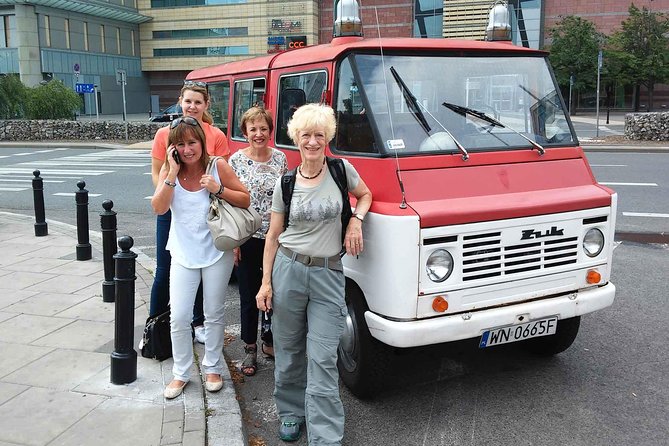
Warsaw for WWII Buffs feels especially interesting because you are not just looking at monuments. You are walking through the same neighborhoods where occupation policies, everyday fear, and resistance all left physical traces in the city fabric. You’ll move in a retro Żuk minibus, which keeps the pace human while still covering a lot of ground.
Two things I really like: the tour gives you clear historical connections between events, not random stops, and the guides (people like Konrad, Tom, Marcin, Karol, and Lukas) are repeatedly praised for strong English and for answering questions in a conversational way. One possible drawback to consider is that the “vintage vehicle” experience can vary, since a guest noted the vehicle they received was not exactly what was shown in the description, and some classic vehicles may be less comfortable for getting in and out.
Key highlights at a glance
- Retro Żuk rides make a heavy topic feel easier to handle, because you can cover distances without long gaps on foot
- Hotel pickup within 3 km of the city center saves time, and your guide can recommend a closer meeting point if your place is harder to reach
- Ghetto wall fragments at street-level help you understand how boundaries cut through everyday Warsaw
- Chłodna Street and the bridge story explains how transport routes and control systems intersected
- Muranów and the Ghetto Heroes sites connect remembrance today with what happened during the occupation
- A built-in WWII timeline moves from 1939 invasion through the Warsaw Uprising and into the Soviet aftermath
Why Warsaw’s WWII streets make sense in 3 hours
This tour is built for people who want the story to click fast. In Warsaw, the same streets that look ordinary today can carry layers of wartime meaning. The best part here is that you get a guided narrative that links political decisions to real geography, so you start seeing patterns instead of just collecting facts.
You also get a good balance of intensity and structure. The schedule touches the German invasion and Soviet occupation in 1939, then moves into the Warsaw Ghetto experience, then lands on the memory sites tied to the 1943 uprising and 1944 Warsaw Uprising. You will likely feel the weight of it at certain stops, but the pacing is designed so you can absorb what you’re seeing without feeling lost.
The private format matters too. It is not a rushed group shuffle where you only get a sound bite. The tour can be customized to your interests, and the guides are described as flexible and willing to tailor.
More WWII History Tours in Warsaw:
- World War 2 in Warsaw walking tour in English
★ 4.7 · 237 reviews - Warsaw in World War 2 Walking Tour
★ 5.0 · 26 reviews - Warsaw Uprising and WWII Old Town Walking Tour with Museum
★ 4.7 · 15 reviews
The Żuk minibus, timing, and what to expect on the road
You cover ground by transport, then walk short segments at each stop. That matters because most people do not want a marathon in uncomfortable weather when the topic is emotionally heavy. The schedule totals about 3 hours, and pickup and drop-off within a 3 km radius of the city center is included.
A few practical notes will help you plan:
- The vehicles are historic style classic minibuses, so some may not have seat belts and there is no air conditioning. Heating is provided for winter.
- If you are traveling in hotter months or with mobility limits, dress for comfort and expect a few bumpy minutes.
- The ride time counts inside your 3-hour window. So if your hotel is farther from easy car access, your advisor may suggest meeting closer to the center to keep the actual tour time feeling full.
One guest also pointed out that their vehicle did not match the exact type shown in the description. I would treat that as a “double-check” moment: if the vintage vehicle look is important to you, message ahead to confirm what vehicle you will get.
Stops 1 and 2 in central Warsaw: from 1939 to resistance networks
You start in central Warsaw, where wartime scars still thread through the cityscape. The tour opens with an orientation that helps you get your bearings quickly, so later streets feel less like random navigation and more like chapter headings.
Stop 1 is about context and mapping. You are driving in the retro Żuk to cover a wide range of locations comfortably while still following a historical narrative. Stop 2 then zooms into the late 1930s political climate and the dual pressure on Poland in 1939: the German invasion and the Soviet occupation of eastern Poland. The guide explains how those forces shaped life in Warsaw and how an extensive resistance movement emerged.
Why this early part is valuable: it sets up the logic behind what you will see later. When you reach ghetto sites, it is easier to understand that persecution was not a single moment, but a system that evolved. The tour also frames these events so you understand why Warsaw became a focal point for both occupation control and resistance.
Waliców ghetto wall fragments: boundaries you can actually stand near
Then the tour moves into one of the most haunting parts of Warsaw WWII storytelling: the physical remnants of the Warsaw Ghetto. Stop 3 is at Waliców, where you learn about the tragedy of the Jewish population persecuted and murdered by Nazi Germany. The numbers shared in the tour are stark: about three million Jews lived in Poland before the war, including around 300,000 in Warsaw. In 1940, Nazis established the Warsaw Ghetto, forcibly confining nearly half a million people within its walls.
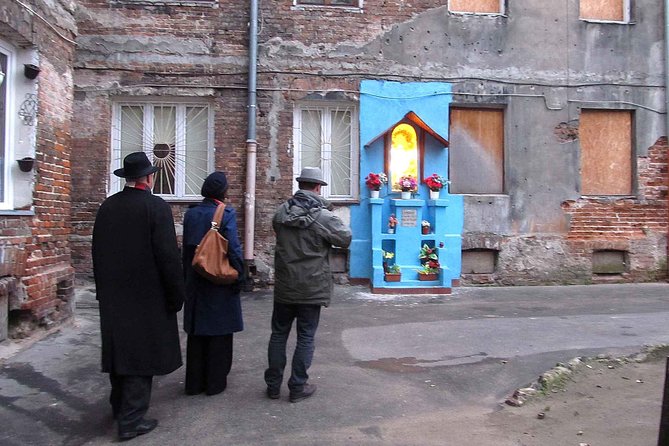
What makes this stop practical is that you are not only hearing history in the abstract. Several fragments of the former ghetto wall remain today, hidden between buildings and along pre-war property lines. Your guide takes you to a preserved section, so you can grasp how the ghetto boundary divided the city into unequal worlds.
Stop 4 adds another layer by focusing on Chłodna Street. In 1941, the ghetto was divided into two parts by Chłodna Street, used for East-West transfer traffic. The guide explains the wooden bridge built near the intersection of Chłodna and Żelazna streets, linking the two parts of the ghetto. It reportedly reached the third floor so that the “Aryan” trams, German military transports, and cars could pass beneath it, just like you see in many photographs.
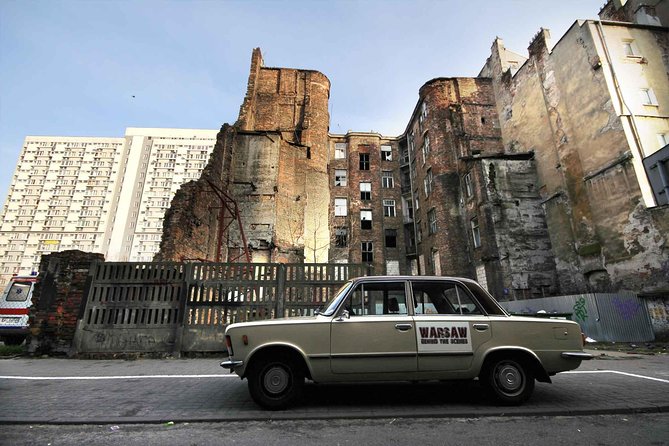
Stop 5 continues right in the same area with the Waliców street tenement house, described as the last ghost from the ghetto since it remains a ruin up to now. You also see a preserved fragment of the ghetto wall at the same place.
What I love about these Waliców and Chłodna segments: you start reading the city like a document. You see where movement was restricted, where traffic was controlled, and how the occupiers designed everyday space to enforce power. If you are the kind of person who likes “how did they make this happen in real life,” these stops deliver.
A consideration: this section is intense. If you prefer lighter pacing, you might want to mentally prepare for emotional weight, because the sites connect directly to persecution and murder.
More to book in Warsaw:
- Warsaw: Chopin Concert in the Old Town
★ 4.8 · 2,287 reviews - Warsaw: Traditional Galar Cruise on The Vistula River
★ 4.6 · 1,640 reviews - Warsaw: Old Town Highlights Walking Tour in English
★ 4.7 · 1,516 reviews - Warsaw Concert: Chopin – Painted by Candlelights with Wine
★ 4.8 · 1,442 reviews
Muranów’s shift from blocks to meaning
Stop 6 takes you to the Muranów district. At first glance, it can look like any normal neighborhood with squared blocks of flats. That is exactly why it works as a stop.
Your guide helps you notice what you would otherwise miss: layers of the past that shaped Muranów and the wider ghetto area. The point is not just nostalgia. It is learning how a city rebuilds and how memory gets written into the places people live.
This is a good “breathing” moment between the most graphic ghetto details and the major remembrance sites ahead. You get a chance to regroup while still moving the story forward.
The Monument to the Ghetto Heroes and POLIN area: remembrance and dialogue
Stop 7 brings you to two key symbolic sites near the place where the first armed clashes of the 1943 Ghetto Uprising occurred: the Monument to the Ghetto Heroes and the POLIN Museum of the History of Polish Jews.
The tour frames this area as more than memorial ground. Today, it represents decades of dialogue, remembrance, and reconciliation among Polish, Jewish, and German communities. That matters because it turns the story from occupation-era suffering into a longer arc of how people live with the past, argue with the past, and build shared public memory anyway.
In a practical sense, this stop is also a time-saver. Instead of sending you to multiple separate places, the tour brings you to a concentrated zone that anchors the uprising story and the museum context in one sweep.
Soviet aggression, Katyń memory, and the Monument to the Fallen and Murdered in the East
Stop 8 shifts the timeline again, and it is a crucial jump. On September 17, 1939, two weeks after WWII broke out in Europe, Poland was attacked by the Soviet Union, and the eastern part of the country was lost forever. The tour explains that after the fall of the USSR, the Monument to the Fallen and Murdered in the East was erected for Poles deported to Gulags in Siberia, killed in executions, and victims of the Katyń massacres.
This stop often hits differently because it shows how suffering in Poland was not only caused by Nazi Germany. It also connects to later historical memory work, meaning how post-war politics shaped what was recognized, honored, and publicly marked.
If you came to Warsaw mainly for Nazi-era ghetto and uprising sites, this stop may widen your understanding fast. It also helps explain why Polish WWII memory is often tied to broader discussions about occupation and subsequent political control.
Warsaw Uprising Monument: the city’s last attempt before the Red Army
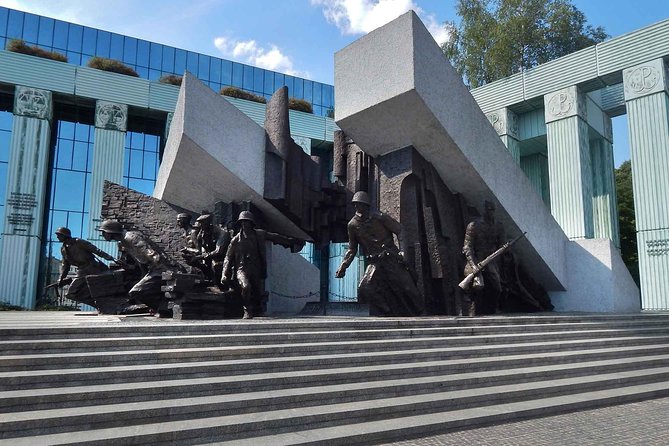
The final chapter lands on the Warsaw Uprising of 1944, described here as the city’s last attempt to regain independence before the arrival of the Red Army. After the uprising’s defeat, Nazi forces systematically destroyed most of Warsaw. Then the Soviet army entered the empty ruins in January 1945, starting a new era of communist rule.
Stop 9 is a short, focused moment in the story, but it is one of the most important ones. You see how the war’s “end” did not mean normal life resumed right away. It also helps you understand why Warsaw became both a symbol of resistance and a reminder of how brutally the occupiers punished hope.
Emotionally, this is where you can feel the whole arc the tour built from the beginning. Politicians set plans, occupiers imposed systems, ghettos created enclosed suffering, resistance rose, uprisings fought back, and the city survived into a new political order.
Price and value: what you get for $169.38 per person
At $169.38 per person for about 3 hours, this is not a budget sightseeing add-on. But it is also not overpriced for what you actually receive on the ground.
Here’s the value logic:
- You get a professional English-speaking local guide who stays with you through a structured, WWII-specific storyline.
- You get transport by retro communist minibus and hotel or apartment pickup and drop-off within 3 km of the city center.
- The tour includes multiple major WWII locations across the ghetto and uprising story, with walking segments at each stop.
- The schedule notes admission tickets are free for the stops listed, which reduces extra costs during the experience.
- Because it is private, you can ask questions without waiting for the next group member to speak.
This price can make the most sense if you are a history-focused traveler who wants the city explained, not just visited. It is also a strong fit for couples, small families, or friends who want customization.
If your group is big enough to fill a minibus, the value often feels better because you share the cost of guide time and transport. On the other hand, if you love total spontaneity and prefer reading on your own, you might find this style of guided pacing less satisfying.
One more small value tip: bring a few specific questions ahead of time. In the reviews, guides are praised for flexibility and for engaging conversation, so your curiosity will be rewarded.
Who should book this Warsaw for WWII Buffs tour
I’d put this tour at the top of your list if:
- you are a WWII buff who likes a clear timeline and real geography
- you want to see ghetto wall remnants and understand how streets were used to divide people
- you prefer a guide who can explain in plain English and answer follow-ups
- you want hotel pickup to keep your day efficient
It is also a good choice if you have already seen some major Warsaw highlights and want the next layer, the wartime layer. The tour takes you beyond the most obvious “look at a plaque” routine and shows how the occupation shaped transport routes, neighborhoods, and how memory is marked today.
If you dislike emotional intensity, plan your day around it. Wear comfortable shoes, expect some walking, and consider this a “serious history morning or afternoon,” not a casual stroll.
Should you book this tour
If your priority is understanding Warsaw during WWII and the immediate aftermath, I think booking is a smart move. The tour is tightly structured around core sites tied to the ghetto and uprisings, and the private format plus hotel pickup makes it easy to fit into a busy itinerary.
Two reasons I’d feel confident recommending it: the guide experience is repeatedly described as thoughtful, flexible, and strong in English, and the route focuses on physical city details you would struggle to piece together alone. The main thing to watch is the vehicle expectation, since classic rides vary, so message ahead if you care about getting the exact vintage model pictured.
FAQ
Is this tour private?
Yes. It is listed as a private tour or activity, so only your group participates.
How long is the tour?
The duration is about 3 hours.
Does the tour include hotel pickup?
Yes. Pickup and drop-off are included within a 3 km radius of the city center. If your hotel or apartment is farther or inaccessible by car, you will be advised on a closer meeting point. Transfer time counts in the total tour time.
What language is the tour in?
The tour is offered in English, with a professional English speaking local guide.
Do I need to buy tickets for the stops?
The schedule states admission tickets are free for the listed stops.
What should I wear or bring?
You will do walking segments at each stop, so wear comfortable clothing and suitable footwear. The vehicles may not have air conditioning and some may not have seat belts, but they do have heating in winter.
Is there a height requirement for children?
Adults and children over 150 cm (4 ft 9 in) can participate. For a child under 150 cm, seat boosters are mandatory under Polish law, so you should contact the tour operator in advance to check availability.
Fresh Warsaw reviews
- Deluxe Polish Food Tour Experience in Warsaw★ 5.0 · 19 reviews
- FSO Gunrange, Shooting Package US ARMY★ 5.0 · 19 reviews
- Gdansk and Malbork Castle Small Group Tour from Warsaw with Lunch★ 4.5 · 20 reviews
- Warsaw Old Town: Spy-Themed Walk & Game with Host★ 4.5 · 19 reviews
- Warsaw Praga Guided Historical Walking Tour★ 4.5 · 21 reviews
- Warsaw: Extreme Shooting Range Experience with Transfers★ 5.0 · 21 reviews
- Warsaw : Private Walking Tour With A Guide ( Private Tour )★ 4.4 · 22 reviews
- A Journey Through Old Town Warsaw★ 5.0 · 22 reviews
WWII History Tours, compared.
World War Two in Krakow: Jewish Quarter & Ghetto Tour
Read our review →
III Reich & WW2 in Wroclaw. Monday, Wendsday, Friday regular tour
Read our review →
Museum of the Second World War Gdansk Private Tour & Tickets
Read our review →
Gdansk Private WWII Tour with Museum of the Second World War
Read our review →Browse the lists this tour appears in