
Reviewed · HISTORICAL TOURS
Warsaw History and Reality Walking Tour
Warsaw has two faces at once, the scars and the comeback. This walking tour turns those big ideas into real corners you can point at, from the mermaid on the quay to the squares and streets rebuilt after WWII. I love how the stories stay specific, not vague, and I love that you get a mix of iconic sights plus the kind of in-between details you would usually miss. Pomnik Syreny sets the tone fast, with legend, symbolism, and WWII-era context.
My other favorite part is the view break at the University of Warsaw Library. You get a rooftop garden listed as open from April to October, plus a river-and-city panorama that makes the Vistula feel close and usable, not just something you pass by. It is a smart pace reset during a mostly-on-foot day.
One thing to plan for: that rooftop garden is seasonal. If you go outside April to October, you may still get terrace access, but you should expect a different feel than the garden season.
Key highlights you should not skip
- Pomnik Syreny explains why the mermaid belongs in Warsaw’s coat of arms, including the model story and a WWII connection
- University of Warsaw Library rooftop gives a real break, with river views and a green space when it is open (April to October)
- A post-WWII workers’ district shows how Warsaw rebuilt for the people doing the rebuilding
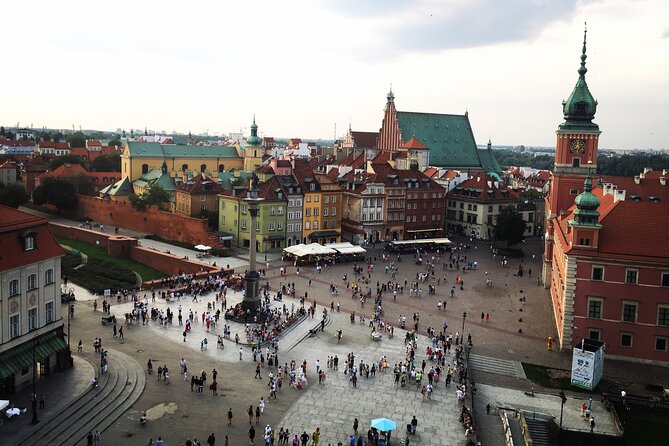
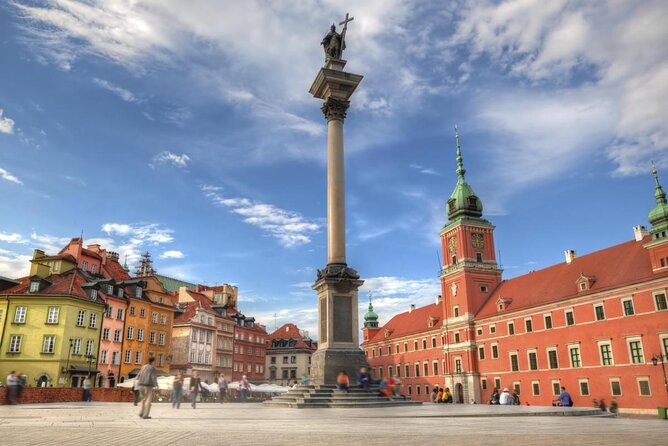
- St. Anne’s Church and Royal Castle Square area pairs baroque drama with carefully reconstructed Old Town streetscapes
- Old Town lanes let you see cobblestones, facades, churches, and the tiered burghers’ tenement vibe in one walk
- Krakowskie Przedmieście and Pilsudski Square connects the Royal Route with the Presidential Palace lions and the Unknown Soldier memorial
From Mermaid Myth to Post-War Warsaw, a smart 2.5-hour format
The best Warsaw tours do two jobs. They help you place what you see on a map, and they explain why the city looks the way it does. This one does that in a practical way, because the route keeps moving from one “meaning zone” to the next.
I like that the pace is designed for attention. You are not speed-walking through photos. You stop often enough to absorb details, then you walk again while your brain is still warmed up.
The group stays small, with a maximum of 10 people, and the tour is offered in English. That matters because you can ask follow-up questions and still keep things flowing.
More Historical Tours in Warsaw
- Warsaw: POLIN Museum of the History of Polish Jews Ticket
★ 4.7 · 1,142 reviews - Warsaw: Chopin Concert at Historical Venue in Old Town
★ 4.7 · 445 reviews - Small-Group Historical Guided Tour of Warsaw with pick up/drop off. Public Tour.
★ 4.5 · 343 reviews
Pomnik Syreny, where the mermaid is more than a pretty statue
You start at the Mermaid statue area, meeting near the General George’a Smitha Pattona location. The point of this stop is simple: the mermaid is not random decoration. You learn why she appears in Warsaw’s coat of arms, and you hear the story about the sculptor’s model.
Then the tour adds the layer that makes Warsaw history feel real. The mermaid story ties into WWII, so you are not only collecting folklore. You are getting a sense of how symbols can carry meaning even when everything else is being disrupted.
Practical note: this is a short stop, around 10 minutes. Treat it like your opening briefing for the entire walk. Once you understand the mermaid theme, the rest of the route makes more sense.
University of Warsaw Library rooftop views, plus a seasonal green pocket
Next comes the Warsaw University Library area and the rooftop garden concept. The rooftop garden is listed as open from April to October, so in warmer months you get that extra “pause and breathe” element. Even when the garden is not active, the idea here is the same: a modern library that also respects the Vistula embankment shape.
The best value of this stop is the viewpoint. You can look out toward the river and the city, and that does something important for first-time visitors. It turns Warsaw from a set of buildings into a layout you can actually understand.
The tour also includes an entrance ticket for a viewing terrace. So you are not just told about the view, you are set up to see it.
If you are the type who likes photo moments, this is where I would plan your break. It is also a good time to ask your guide how the city’s post-war rebuilding shaped what you will see in the Old Town stretch ahead.
The first post-WWII rebuilt district, built for the workers
After the library viewpoint, you walk into a more “people-powered” part of the story. This stop is about the first district in Warsaw rebuilt after WWII, designed to serve the workers involved in reconstructing the Old Town.
This is one of those ideas that changes how you read a city. You stop seeing reconstruction as an abstract project. You start recognizing it as labor, housing, and day-to-day survival for the people doing the work.
The drawback here is subtle. The tour description is more concept-based than monument-based, so if you only want grand architecture, you might wish for a named landmark. But if you like understanding how cities function, this stop is a standout.
More Walking Tours in Warsaw
- Warsaw: Old Town Highlights Walking Tour in English
★ 4.7 · 1,516 reviews - Warsaw: Old Town Guided Walking Tour
★ 4.9 · 599 reviews - Half-Day Polish Food Walking Tour with Guide and Dinner
★ 4.5 · 381 reviews - Warsaw: Warsaw Ghetto Private Walking Tour with Hotel Pickup
★ 4.9 · 369 reviews
St. Anne’s Church and the Royal Castle square, baroque drama meets reconstruction
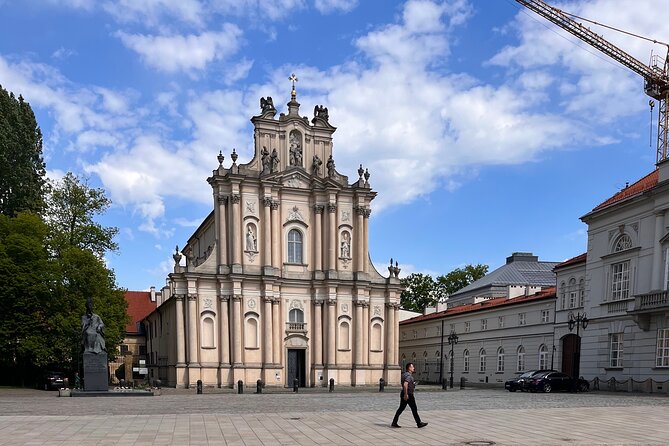
Then you move to St. Anne’s Church, which is known as one of the most beautiful baroque churches in Warsaw. This is where the tour balances sweeping stories with craft and detail, because baroque churches reward slow looking even in a short visit.
From there, you connect to the Royal Castle square area, and you look at reconstructed tenement houses tied to the Old Town. This part works because it shows the city’s “back from the edge” approach. Warsaw was rebuilt with intent, and you can see that intent in how the streetscape was restored.
A practical thing to keep in mind: churches can mean crowds and busy sight lines, depending on the time of day. Your guide helps you focus, so you do not wander aimlessly. You learn what to notice instead of just trying to take in everything at once.
Old Town streets and lanes, cobblestones with a point
Old Town is next, with cobblestone Gothic streets and alleyways. The tour experience here is about texture and pattern. You get a sense of how churches and tiered burghers’ tenement houses create that layered look, where buildings stack in ways that feel both dense and orderly.
There is also mention of a favorite place of lovers. That matters in a funny way because it grounds the “big history” in everyday life. Yes, the area is reconstructed to reflect a past atmosphere, but it is also a place people still choose for romance, walks, and photos.
What I like most about the Old Town segment is how it sets you up for the next stretch. You leave Old Town with a stronger feeling for why Warsaw’s center looks the way it does, and you are ready to spot political and cultural power along the Royal Route.
Krakowskie Przedmieście, the Royal Route with Presidential Palace drama
Krakowskie Przedmieście is described as a 2.5 mile Royal Route. That is a long enough stretch to feel like a real walk, not a series of tiny stops. And along the way, you get monuments and important buildings that help you understand Warsaw’s cultural and political center.
One highlight is the Presidential Palace, a neo-classic building where the Polish president resides. You also hear about the famous four lions guarding it, sculpted by Camilio Laudini. The date marker that comes up is part of what makes it memorable: they are described as more than 200 years old.
Then the tour drops in a personal music detail that I genuinely think sells the place. At age 8, Frederic Chopin played publicly there for the first time. That turns a formal building into a story you can feel, because you can picture a young musician walking into history.
This section is also a good chance to notice how the city shifts from Old Town’s tight lanes to broader civic space. It helps your brain map Warsaw as you go.
Pilsudski Square and the Unknown Soldier, plus a calm garden behind it
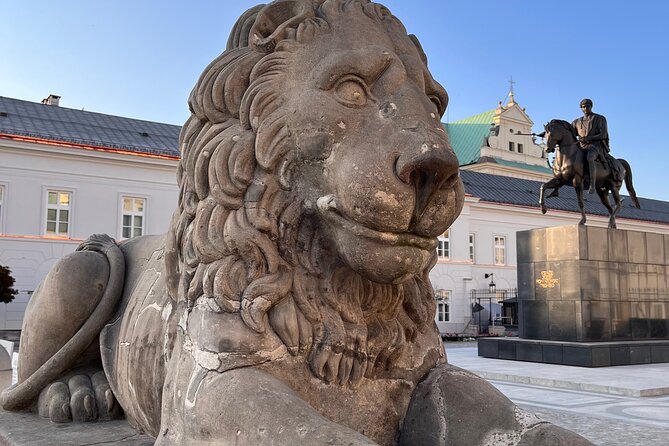
The walk ends at Plac Marszalka Jozefa Pilsudskiego, a parade square with the memorial of the Unknown Soldier. This is an important Varsovian meeting point for concerts and events, so it is not only a monument you pass. It is a real public stage.
Behind the memorial you reach the Saxon Garden. That back-pocket green space is a nice contrast after the more formal civic feel of the square.
This ending works well for a first trip because it does two things at once. It leaves you with a strong emotional image tied to national memory, and it gives you a practical “what now” area where you can sit, regroup, and continue exploring on your own.
Your tour finishes at the Roman Catholic Church of the Visitants on Krakowskie Przedmieście 34, near the Cardinal Stefan Wyszyński statue. Use that as your mental anchor for where the main walk ends.
Price and value: what $114.39 buys you in real-world terms
At $114.39 per person for about 2 hours 30 minutes, this is not a bargain-basement walking tour. But you are paying for a small group, English-language guiding, and an attraction component.
The math looks better when you remember what is actually included and what is free. The tour lists free admission for key stops like Pomnik Syreny, the churches and Old Town walking areas, and more. The included part is specifically the entrance ticket for a viewing terrace, which is valuable because views are harder to get on your own without planning.
Also, tours at this price point often win or lose based on guide quality. Here, multiple accounts emphasize storytelling, adaptability, and the ability to answer both broad questions and small curiosities without shutting you down. If that sounds like your travel style, the price feels more reasonable.
Logistics that matter: timing, tickets, and how to plan your day
The tour runs about 2 hours 30 minutes and uses a mobile ticket. You are also near public transportation, which makes it easier to start on time or adjust if your day schedule slips.
Two small planning points:
1) Bring water and a snack plan. Coffee or tea is not included, so you may want to decide in advance where you will stop afterward.
2) Dress for weather. The experience requires good weather, so rain or wind can change your plan.
Because the rooftop garden is open April to October, your season affects what you see most clearly at the library viewpoint. If you travel in colder months, plan your expectations around the view and the terrace rather than the garden atmosphere.
Who this walking tour is best for
This is a great fit if you want more than postcard facts. You like understanding why Warsaw looks rebuilt, not just admiring what was restored. It is also well suited to people who prefer small groups and a guide who can follow your pace and questions.
It also works for mixed groups. From teens to adults, people can enjoy the stories and the mix of architecture, monuments, and everyday symbolism.
If you only want a strictly linear highlights tour with minimal interpretation, you might find some stops more conceptual, like the post-WWII workers’ district segment. But if you enjoy connecting dots, that is where the tour pays off.
Should you book Warsaw History and Reality?
I would book it if you fit two conditions. First, you want a guided walk that makes sense of Warsaw’s layers, especially the rebuilt center and the meaning behind symbols. Second, you care about having time to ask questions, because the tour is small and the guiding style is clearly built for interaction.
Skip it or consider an alternative only if you are visiting outside April to October and you are specifically chasing the rooftop garden vibe. The rest of the route still delivers, but that seasonal piece may change the feel.
If your ideal Warsaw day includes mermaid symbolism, baroque churches, Old Town streets you can walk slowly, and a strong ending at Pilsudski Square, this one hits a lot of targets in one go.
FAQ
How long is the Warsaw History and Reality Walking Tour?
It is approximately 2 hours 30 minutes.
Is the tour offered in English?
Yes, it is offered in English.
What is included in the price?
The price includes an entrance ticket for a viewing terrace.
Are there admission fees for the stops?
The tour lists admission ticket free for the stops described, and the viewing terrace ticket is the included item.
When is the rooftop garden open at the University of Warsaw Library?
The rooftop garden is listed as open from April to October.
Where does the tour start and where does it end?
It starts at the Mermaid statue area near General George’a Smitha Pattona, and it ends at the Roman Catholic Church of the Visitants on Krakowskie Przedmieście 34.
How large is the group?
The tour has a maximum of 10 travelers.
What happens if weather is poor or the day does not work out?
The experience requires good weather. If it is canceled due to poor weather, you are offered a different date or a full refund. Free cancellation is available, and you can cancel up to 24 hours in advance for a full refund.
Fresh Warsaw reviews
- Warsaw: Wolf’s Lair & Swieta Lipka Small-Group Tour + Lunch★ 5.0 · 3 reviews
- World War II Warsaw Old Town, Military Cemetery Walking Tour★ 4.7 · 3 reviews
- Warsaw: Old Town Walking Tour, Hidden Gems & Hot Chocolate★ 4.3 · 3 reviews
- Warsaw: Explore the Vistula on Its Longest Speedboat Route★ 4.6 · 3 reviews
- 5-hour: Royal Castle, Old Town and POLIN Museum/inc.Pick-up/★ 5.0 · 3 reviews
- Museum of Modern Art in Warsaw★ 5.0 · 3 reviews
- Majdanek – German camp from II World War – Private Tour – 1 DAY TRIP FROM WARSAW★ 5.0 · 3 reviews
- Warsaw Outdoor Paintball with Transfers (all year round)★ 5.0 · 3 reviews
Historical Tours, compared.

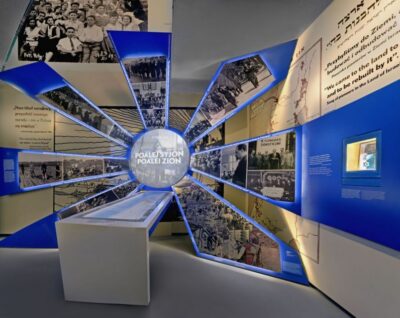
POLIN Museum of the History of Polish Jews Ticket
Read our review →
Gdańsk City Sights & History Guided Walking Tour in English
Read our review →


Tipsy Polish Food Tour With History, Pierogi & Shots
Read our review →
Browse the lists this tour appears in