
Reviewed · HISTORICAL TOURS
Historic Heart of Warsaw Walking Tour
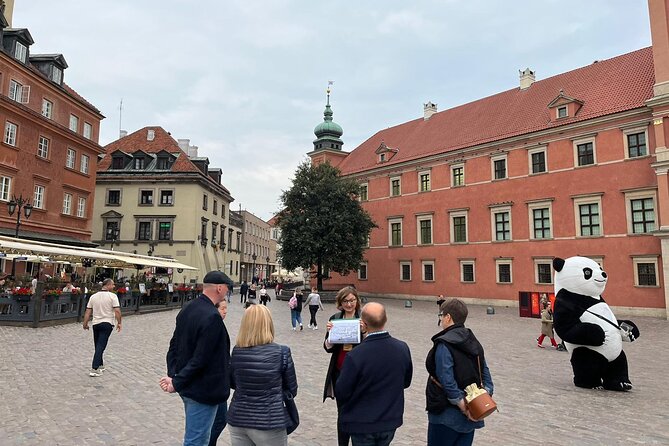
Warsaw’s historic center has a way of changing your mood fast, from royal splendor to hard memory. This Historic Heart of Warsaw Walking Tour keeps you moving through the layers, with an entertaining, story-first guide and a route you can actually absorb in about two hours.
I especially like how it mixes famous landmarks with small stops that you would probably miss on your own. You get the big sights like Rynek Starego Miasta and the Warsaw Ghetto memorial markers, plus quieter moments like Kanonia and the Wishing Bell. One consideration: two museum stops (Royal Castle and the Marie Curie birthplace museum) do not include entry, so you’ll want to budget for those if you plan to go inside.
Key highlights you will feel right away
- Small group size (max 15), which makes it easier to ask questions and keep the pace comfortable
- A mix of major monuments and brief local stops, so you learn fast without being stuck in one place
- Wheelchair-friendly route and service animals welcome, with public transport nearby
- Guides with humor and clear explanations, including examples like Olivia and Agnieszka
- A guided memory walk, with the Warsaw Ghetto boundary markers and the Warsaw Uprising Monument
Why this 2-hour heart-of-old-town walk is a smart use of time
This is the kind of tour that helps you get your bearings fast. In Warsaw, the story is not just about buildings. It is about power, survival, rebuilding, and everyday life you can still picture when you stand in the right spot. In two hours, you cover a compact loop through some of the city’s most important areas, then end at a major monument where the mood turns reflective.
I like that the structure makes sense. You are not just “touring,” you are following a path that connects the past in a way that clicks. One minute you are looking at a royal monument, the next you are at medieval defensive walls, then you are at memorial plaques tied to the 1940 ghetto boundary. That jump in themes can feel heavy, but it is also the point. You leave with context, not just photos.
The pacing is also realistic. Most stops are 5 to 15 minutes, which works well if you want learning without long waits. It also makes the tour easier to pair with other plans later in the day.
More Historical Tours in Warsaw
- Warsaw: POLIN Museum of the History of Polish Jews Ticket
★ 4.7 · 1,142 reviews - Warsaw: Chopin Concert at Historical Venue in Old Town
★ 4.7 · 445 reviews - Small-Group Historical Guided Tour of Warsaw with pick up/drop off. Public Tour.
★ 4.5 · 343 reviews
Meeting point, route end, and how to plan your day
You start at Sigismund’s Column (Plac Zamkowy) in central Warsaw. You end at the Warsaw Uprising Monument (Plac Krasińskich). The tour finish is about a 15-minute walk from the start area, and your guide can explain how to get back if you need help.
For your day plan, treat this as a “core” activity, not a standalone. If you do it early, you will understand what you are seeing later in the Old Town. If you do it in the afternoon, it still works, because the route hits key visual anchors and ends on a big symbolic note that makes subsequent sightseeing more meaningful.
A nice detail: the group is capped at 15 travelers, which usually means less shuffling around and more chance to hear the guide clearly. The tour also uses a mobile ticket, so you do not need to worry about printing anything.
Stop 1: Royal Castle in Warsaw, plus what to do with the entry fee
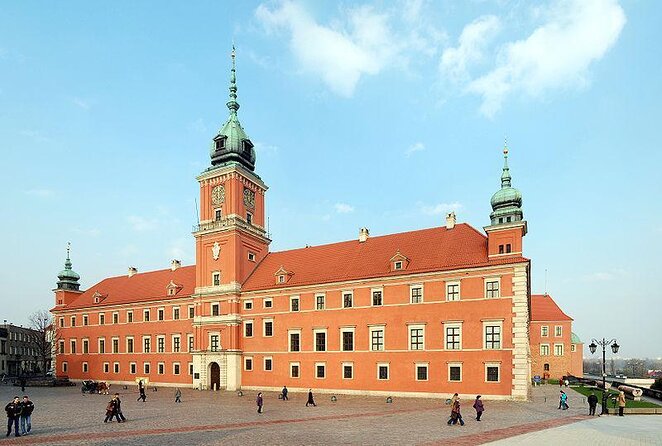
Your first major stop is the Royal Castle in Warsaw (museum). This is the place where the city’s royal storyline becomes physical. Even if you spend only a short time at the museum area, the setting helps you understand why Warsaw mattered politically, not just aesthetically.
Important for planning: admission to the Royal Castle is not included. That does not make the stop useless. It still sets context for what you will hear next. But if you want the full experience inside, you should be ready to pay the ticket separately.
Practical tip: if you are the type who hates adding extra stops later, consider whether you will actually go in at that moment. If you are more of a “listen and observe” person, you can treat it as a framing stop, then focus your energy on the free outdoor monuments that follow.
Stop 2: King Sigismund’s Column and why it matters in Warsaw
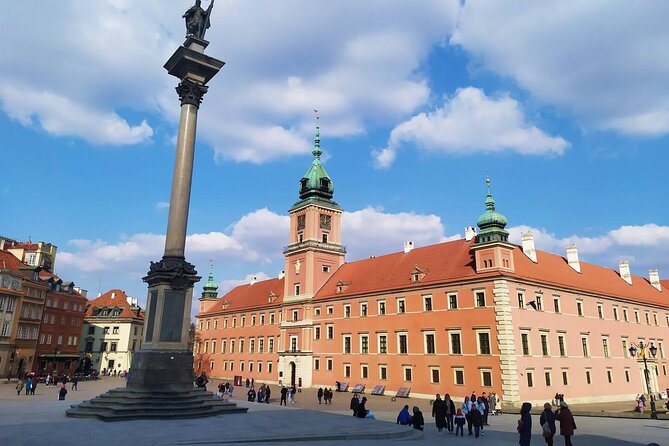
Next you reach King Sigismund’s Column (Kolumna Zygmunta). This is a tall, unmistakable monument with a statue of one of Poland’s kings. The value of this stop is how the guide typically connects a single monument to a larger message about legitimacy and identity.
Even with a short time here (about 10 minutes), this stop can help you understand the way Warsaw projects authority. Look at it as a visual “anchor.” When you later see other defensive and civic structures, you will start noticing how the city signals power from different angles.
Admission is free here, so there is no decision point. It is a good “warm start” after the first stop, especially if the group needs a quick breather.
More Walking Tours in Warsaw
- Warsaw: Old Town Highlights Walking Tour in English
★ 4.7 · 1,516 reviews - Warsaw: Old Town Guided Walking Tour
★ 4.9 · 599 reviews - Half-Day Polish Food Walking Tour with Guide and Dinner
★ 4.5 · 381 reviews - Warsaw: Warsaw Ghetto Private Walking Tour with Hotel Pickup
★ 4.9 · 369 reviews
Stop 3: Kanonia, a quiet corner that adds real local flavor
Kanonia is a small square at the rear of the Cathedral of Saint John the Baptist. It is the kind of place you might walk past without knowing it has a role in the story of the area. That is exactly why I like including it in a tour like this.
This stop is short (around 10 minutes), but it gives you a change of pace from the big monuments. It also helps you see that the historic heart of Warsaw is not only grand facades. It is also side spaces and courtyards that tell you how people moved and lived around the religious and civic core.
Because admission is free, it is a low-commitment stop with high payback. You can just look, absorb, and let the guide’s explanation stick.
Stop 4: The Wishing Bell, 17th-century mystery made social
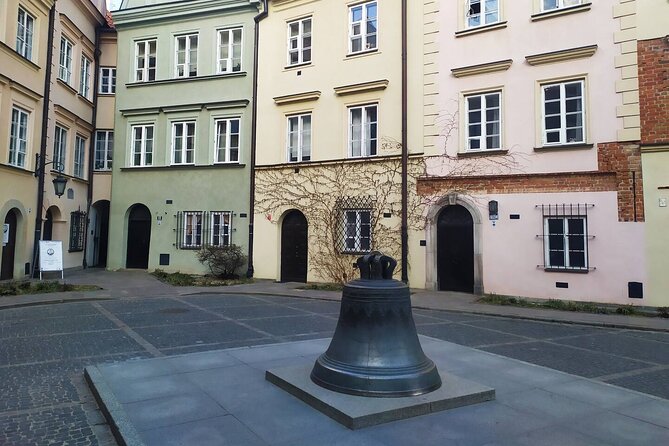
Then comes The Wishing Bell, an old bell from the 17th century that attracts tourists from around the world. This is not a “serious museum object” in the way a castle might be, but it is meaningful in a human way. People gather because the story feels personal.
The stop is quick (about 5 minutes), which is perfect. You get the idea without spending the whole tour at one point. I also like this kind of stop because it breaks up the heavier themes that come later. You are still in historic Warsaw, but you are reminded that ordinary life and public rituals have always been part of the city’s rhythm.
No admission is needed. You are simply there to notice and listen.
Stop 5: Gnojna Gora lookout, a practical pause with big views
Next is Gnojna Gora, a lesser-known lookout point in the Old Town of Warsaw. The payoff is the view: you can see the Vistula River and the area across the river. That perspective matters, because it helps you understand Warsaw as a geography story, not only an architecture story.
This stop is about 10 minutes. For you, that is enough time to take a few photos, look for landmarks the guide mentioned, and reset your brain before the dense cluster of Old Town streets and churches.
Because it is free, it is also a good place to try if you are unsure you will enjoy longer sightseeing. If the view is what you came for, this stop gives it to you in a tidy time window.
Stop 6: Rynek Starego Miasta and the Warsaw mermaid symbol
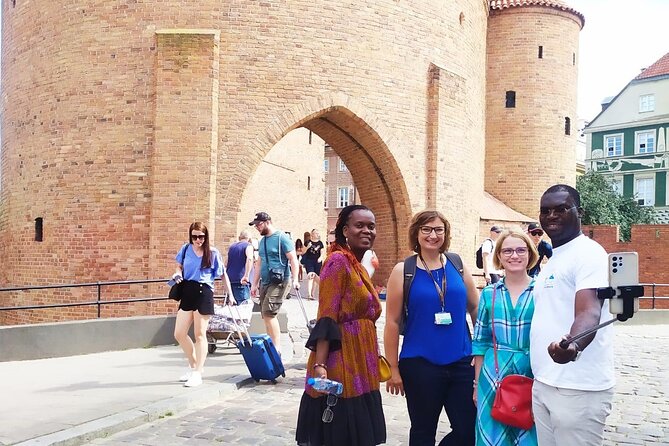
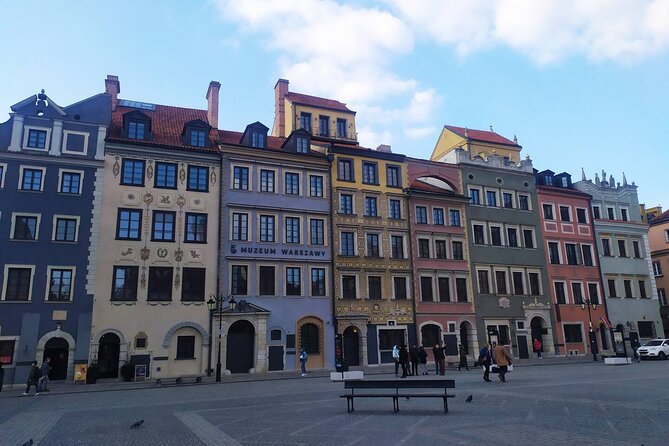
The tour then reaches the Rynek Starego Miasta, the heart of the Old Town. Here you see colorful tenement houses and a monument featuring the symbol of Warsaw, the mermaid.
This is the stop that most people will recognize from photos, but the guide’s job is to help you read the scene. Tenement houses are not just pretty facades. They hint at trade, community life, and the way the city rebuilt and restored its center after major disruptions.
Around 10 minutes here is enough to take in the main visual lines and understand what you are looking at. If you want to linger longer, you will likely want to extend your stay after the tour. But as a guided introduction, this stop works well.
Stop 7: Archikatedra Sw. Jana Chrzciciela, the city’s key church moment
Now you move to Archikatedra Sw. Jana Chrzciciela, described as the most important church in Warsaw. This stop lasts about 10 minutes and functions like a deep breath. After street-level squares and monuments, you get a vertical sense of the city’s identity through religious architecture and its long-standing role.
Admission is free for the stop itself, but the important part is how the guide connects the church to broader themes. You start to see the Old Town as a layered space where power, belief, and community overlap.
If churches are your thing, you may want extra time before or after your tour. If they are not your thing, you will still benefit because this stop helps explain why the surrounding streets feel the way they do.
Stop 8: Warsaw Barbican, medieval defense you can still picture
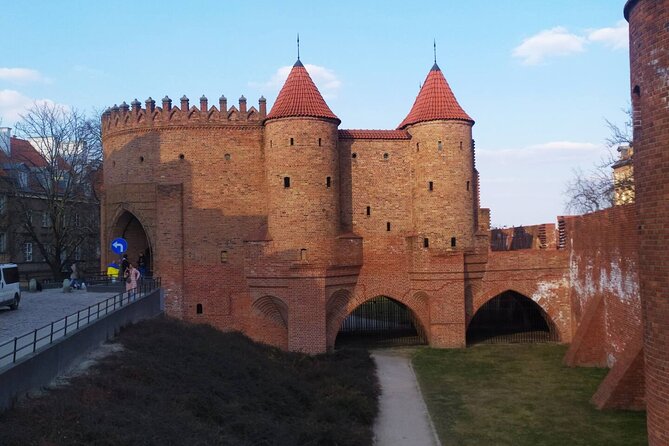
Next up is the Warsaw Barbican (Barbakan Warszawski). This is a set of medieval defensive walls that once encircled Warsaw. Even if your focus is not military history, you can still enjoy the structure. It gives you a tangible sense of how the city tried to protect itself.
This is a short stop (about 5 minutes), but it is well-placed. Right after the church stop, the Barbican shifts you from spiritual center to physical defense. It is also a helpful bridge to the darker memory stops that follow later.
Because the stop is free, you do not face any extra ticket decisions. You simply look, learn, and move on.
Stop 9: Maria Skłodowska-Curie museum, optional but memorable
Then the tour heads to Muzeum Marii Sklodowskiej-Curie, focused on the birthplace of Maria Skłodowska-Curie, a double Nobel prize winner. This stop is about 10 minutes, and it is a great contrast to the wartime stops later.
Important again: entry ticket to the Marie Curie Museum is not included. You will still get context from the stop, but if you want to go inside, you must plan that separately.
For many people, this is the emotional relief valve. After heavier memorial sites, a scientific figure with a global legacy can reset your brain. If you are deciding where to spend extra money, this is one place you might consider prioritizing, assuming the ticket cost fits your plans.
Stop 10: Warsaw Ghetto boundary markers, where history becomes specific
The tour moves into one of the most serious parts of the experience: the Warsaw Ghetto. Here you focus on boundary markers, memorial plaques marking the maximum perimeter of the former ghetto established in 1940.
This stop is about 10 minutes and includes no admission fee. The reason it is so important is that it turns a huge historical event into something you can locate. Instead of thinking only about dates and facts, you start mapping the tragedy onto the city streets.
One consideration: this portion can feel emotionally heavy. If you are traveling with kids, or if you prefer lighter sightseeing that day, you may want to mentally prepare. Also, keep in mind the guide’s explanations may go beyond simple description, since the goal here is understanding.
Stop 11: Warsaw Uprising Monument, the ending that makes sense
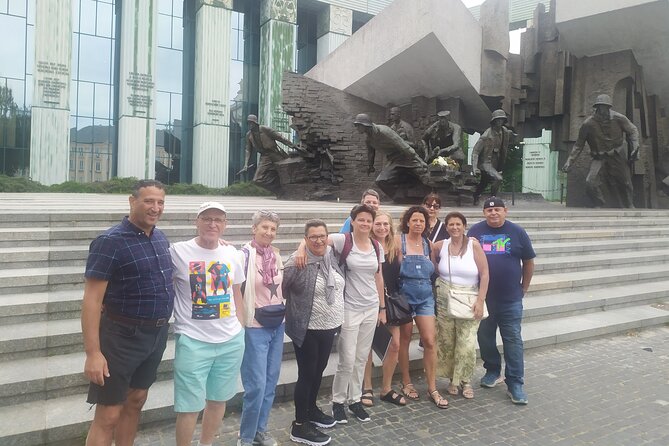
Finally, you arrive at the Warsaw Uprising Monument, a memorial dedicated to the Warsaw Uprising of 1944. This is your ending point. It helps the story land in a clear, respectful way.
The tour ends in front of the monument, and the guide can offer instructions on getting back. Since this is the last stop, it is also a good moment to ask final questions. Use it to connect the themes you saw earlier, from royal symbols to defense structures to survival and resistance.
This is the stop where the tour feels most complete. You are not leaving Warsaw’s historic center as a collection of sights. You are leaving with a storyline, and that makes later self-guided sightseeing far easier.
What you get for $28.75, and why this can be good value
At $28.75 per person for about two hours, you are paying for interpretation. That is the real product here. The free monuments make the route look inexpensive, but the guide’s job is to connect what you see to what it means, and that is where tours like this justify the cost.
You also get some practical extras: a full info pack about Warsaw prior to your tour, including FAQ-style help, visual aids, and recommendations about more places to visit, where to eat, and where to drink. That matters because it helps you turn a single tour into a smarter itinerary for the rest of your trip.
Most tours try to be everything. This one stays focused on key historic anchors, then hands you tools to explore further. And because it is limited to a maximum group size of 15, it tends to feel more personal than large-city cram sessions.
In the guide department, the strongest signal from past experiences is humor plus clarity. Names like Olivia and Agnieszka come up for their sense of humor and how well they answer questions. That combination is why people finish the walk feeling like they actually understood Warsaw, not just followed a route.
Who this tour fits best, and who may prefer something else
This tour is a strong fit if you want a guided way to understand Warsaw’s center without spending your whole day inside museums. You get the Old Town core, plus major memory sites, plus a church and fortress-style stop, all in one logical loop.
You will likely enjoy it most if you like your sightseeing with context. If you prefer only “pretty photos” and you want minimal explanation, you might find the heavier history portion less fun. But even then, the structure gives you control. Short stops keep you from being trapped in any one theme too long.
It also works well for people who want flexibility. Most stops are free, and you can choose whether to add the paid museum entries at the Castle and the Marie Curie Museum.
Finally, since the tour is wheelchair-friendly and allows service animals, it is designed for broader participation than some rough-and-tumble walking tours.
Should you book the Historic Heart of Warsaw Walking Tour?
I think you should book it if you want an efficient, story-focused introduction to Warsaw’s historic heart, especially if it is your first time in the city. The route is short enough to feel doable, but it hits the major anchors that help you understand what you are looking at later.
Skip it or supplement it if you already know the city’s history and you want more time for independent wandering. Also consider whether you want to pay for the Royal Castle and the Marie Curie Museum. If you do, this tour becomes an even better value because it sets you up to get more from those visits.
Bottom line: for two hours and $28.75, you are buying guide-led clarity, a compact Old Town orientation, and a respectful walking path through both monuments and memory. If that is your travel style, this one is a very good bet.
FAQ
Is the tour offered in English?
Yes. The tour is offered in English.
How long is the Historic Heart of Warsaw Walking Tour?
It lasts about 2 hours.
What is the price per person?
The price is $28.75 per person.
Are museum tickets included?
No. Entry to the Royal Castle in Warsaw is not included, and entry to the Maria Skłodowska-Curie Museum is also not included. The other listed stops are free.
Where does the tour start and end?
It starts at Sigismund’s Column (Plac Zamkowy) and ends at the Warsaw Uprising Monument (Plac Krasińskich).
Do I get a mobile ticket?
Yes. The tour includes a mobile ticket.
Is it wheelchair-friendly and are service animals allowed?
Yes. The tour is wheelchair-friendly, and service animals are welcome.
What size is the group?
The tour has a maximum of 15 travelers.
Is cancellation allowed if my plans change?
Yes. Free cancellation is available up to 24 hours in advance for a full refund.
Fresh Warsaw reviews
- Warsaw Off The Beaten Path Self-Drive Tour★ 5.0 · 18 reviews
- Private Warsaw Chopin Airport One Way Transfer★ 5.0 · 18 reviews
- Zelazowa Wola: Frederic Chopin Half-Day Private Tour★ 4.7 · 18 reviews
- Warsaw: 2-Hour Chopin’s Life Walking Tour★ 5.0 · 19 reviews
- Warsaw: melt museum Entry Ticket★ 3.5 · 19 reviews
- Deluxe Polish Food Tour Experience in Warsaw★ 5.0 · 19 reviews
- FSO Gunrange, Shooting Package US ARMY★ 5.0 · 19 reviews
- Warsaw Old Town: Spy-Themed Walk & Game with Host★ 4.5 · 19 reviews
Historical Tours, compared.

POLIN Museum of the History of Polish Jews Ticket
Read our review →
Gdańsk City Sights & History Guided Walking Tour in English
Read our review →


Tipsy Polish Food Tour With History, Pierogi & Shots
Read our review →
Browse the lists this tour appears in