
Reviewed · JEWISH HERITAGE TOURS
Krakow Jewish Ghetto and Quarter Audio Guided Walking Tour
This audio walk is interesting because it turns Kraków’s Jewish Ghetto and Jewish Quarter into a real walking story, not just a set of sights. You follow a step-by-step GPS route, hearing what happened at each stop as you move through the streets. I love the GPS location-aware guidance, and I also like that it’s ready on your phone whenever you are, not tied to a fixed group schedule.
One consideration is that there is no human guide, so the whole experience depends on your phone, headphones, and the app working smoothly. I found that this kind of audio tour is still very doable, but if your device misbehaves, you will have to slow down and sort it out.
Key points
- GPS step-by-step route keeps you oriented through the Ghetto and Jewish Quarter
- All outside, mostly short stops makes it easy to manage time and pacing
- Murals and public art (Robot mural and Blu’s Never Follow) add modern layers to the WWII story
- Film and survival connections bring context at Schindler’s List Passage and nearby sites
- Repeat anytime format with a virtual follow-up after your walk
- Finish at the Galicia Jewish Museum for a book-and-mural sendoff
Starting at Plac Bohaterów Getta, where the route hits hardest first
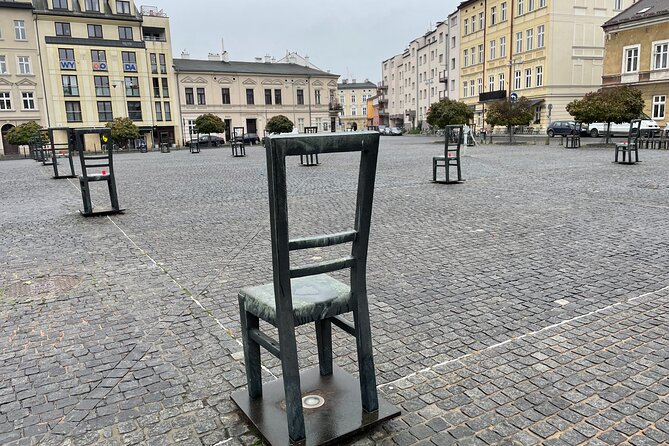
The tour begins at Plac Bohaterów Getta. This is a strong opening point because it sets the tone right away: you are in the Kraków Ghetto area, on ground connected to murders and terror. The audio is built to help you understand the place before you start bouncing between monuments, bridges, and street corners.
I like how the start doesn’t feel like a lecture. It’s more like the city itself becomes the lesson, with the narration nudging you to look up, look around, and connect what you see to what happened.
Because it’s all outside, you do not waste time finding ticket windows or waiting for entrances. The flip side is weather matters, so dress for rain or cold and keep your phone battery topped up.
More Jewish Heritage Tours in Krakow
- Krakow: Schindler’s Factory & Ghetto Guided Tour
★ 4.7 · 1,694 reviews - Krakow: Jewish Quarter and Former Ghetto Tour
★ 4.9 · 1,441 reviews - Krakow: Bike Tour of Old Town, Jewish Quarter and the Ghetto
★ 4.9 · 1,155 reviews
Jewish Ghetto Memorial and the story of hope in the middle of atrocity
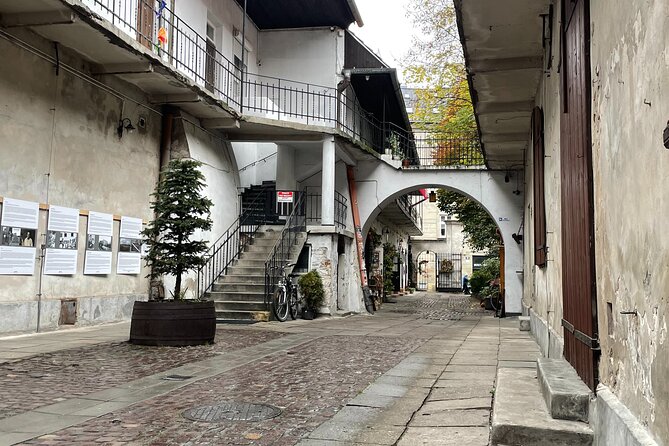
Very close by, you reach the Jewish Ghetto Memorial area, where the audio shifts into specific stories of what happened here. You’ll hear about how people were trapped, how violence unfolded, and also how moments of hope appeared in the middle of catastrophe.
This is one of the benefits of an audio format for a sensitive topic: you can control your pace. You can pause, listen again, or simply stand for a moment when your brain needs a break from the details.
The narration also aims to keep you grounded in the geography, not just the big picture. That matters because the Ghetto story is tied to streets and boundaries, not abstract history.
A “pharmacy that tried” stops you in your tracks
Later, the route brings you outside a museum stop tied to a person who ran a pharmacy and tried to save people. The audio explains how he used his work to help, and why that kind of everyday role became so dangerous in the Ghetto context.
Even if you are not the type who reads every memorial plaque, you’ll likely appreciate this stop. It gives you a human scale to the story, instead of only names and dates. It’s also a reminder that history often turns on small, risky actions.
Practical tip: keep your headphones on for this segment. The point is to listen as you stand there, not after you’ve walked away.
Mayamural Robot and Blu Never Follow, where art keeps the conversation alive
After the memorial zones, the tour moves into public art. You’ll see Mayamural and hear about its connection to the Kraków Ghetto, including how murals can carry memory across generations.
Then you reach mural Blu Never Follow, a short stop that comes with context about why it was painted here. The narration also addresses how Jewish people were targeted and clears up myths that can grow when people do not have accurate information.
I like this part of the walk because it changes the mood in a controlled way. You go from memorial seriousness to the way modern artists and communities respond to it. It also helps you notice something you might otherwise miss: street art isn’t only decoration. It can be a map of memory.
More Walking Tours in Krakow
- Old Town Krakow & Wawel Castle Walking Tour
★ 5.0 · 1,508 reviews - Creepy Krakow: 2-Hour City Walking Tour
★ 4.7 · 1,131 reviews - Krakow: The Old Town Walking Tour
★ 4.8 · 794 reviews - Krakow: Kazimierz Jewish Quarter Walking Tour
★ 4.8 · 571 reviews
The statue and the bridge, Juliusza Lea to Father Bernatek
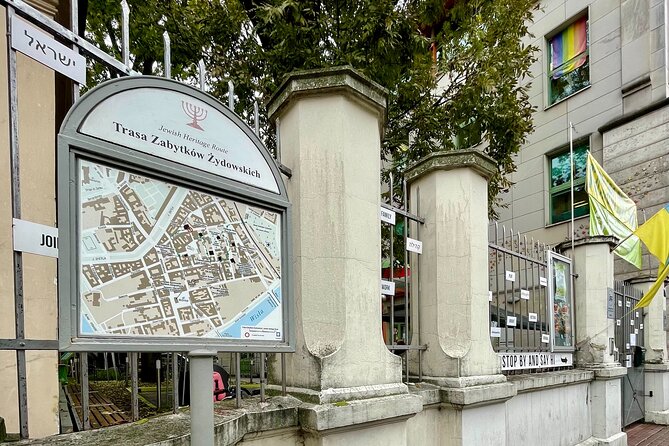
Next you’ll see Pomnik prezydenta Juliusza Lea, where the audio explains the role of the old mayor in developing Kraków. It’s a quick stop, but it helps you understand that the Jewish Quarter was never just a WWII scene. It was a living neighborhood before and after the darkest years.
Then comes one of the most practical and symbolic moments: Father Bernatek’s Bridge. As you cross the Wisła River on this bridge, you’ll hear the bridge story and the way the figures on it relate to the journey from one side of history to the other, toward the Jewish Quarter.
This stop is good for getting your bearings. Bridges are natural pacing tools. You can catch your breath, take a photo if you want, and let the narration reframe what you are walking into next.
Plac Wolnica, then the Jewish Quarter opens like a walking map
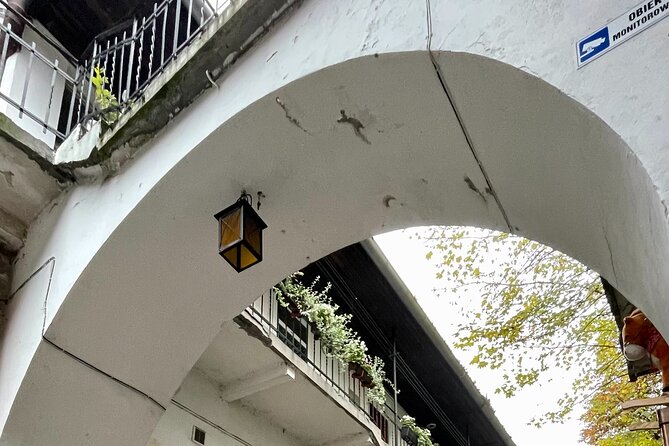
At Plac Wolnica, you explore a square with audio that covers its founding and history. This is one of those segments where the details are less about one single event and more about how the neighborhood formed and functioned over time.
From there, you spend time in the Jewish Quarter, with the audio guiding you through both popular spots and places that feel quieter or less obvious. The narration talks about the Jewish people who lived there, and also about structures and traditions tied to daily life.
If you like “why this street exists” type history, this portion is for you. You get more of the neighborhood feel, not just memorial points.
Schindler’s List Passage, where film and survival history meet
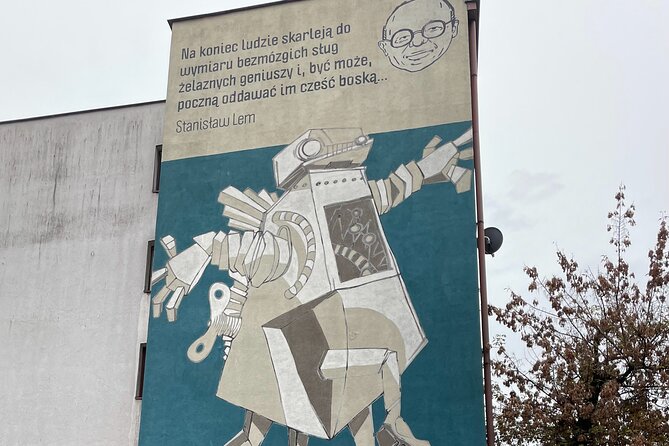
One of the most recognizable named stops is Schindler’s List Passage. You’ll see the site connected to where Schindler’s List was filmed, and you’ll hear how the film’s story connects to the real story of Oskar Schindler and the way he saved many people.
This is a smart inclusion for an audio walk. Film can bring people in, but the audio usefully redirects you back to the real human history. The result is that you leave with both a cultural reference point and a deeper understanding of why the filming location matters.
One caution: if you’ve only seen the movie and not the history behind it, treat this stop as a beginning, not an ending. Let the narration build the context while you are there.
Outside Tempel Synagogue, history that still shapes the present
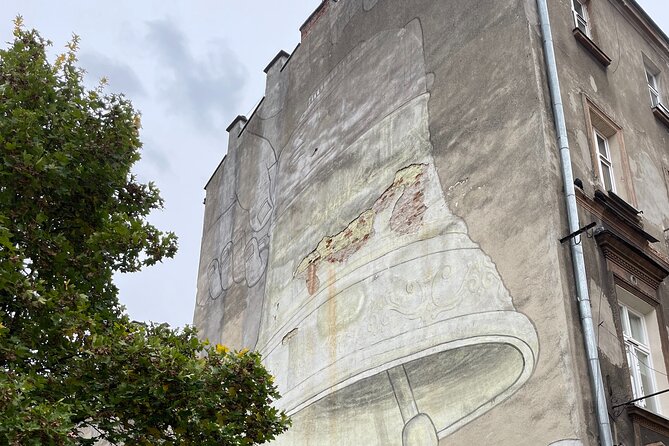
The route also includes the outside of the Tempel Synagogue (Kraków). The audio explains its history and how it impacted the community in the past and the present.
Because this is an outside viewing moment, you don’t need to hunt for a time slot or pay an entrance fee. You still get the key context, and you can decide later whether you want deeper access through another visit.
If you enjoy architecture and cultural landmarks, you might find yourself slowing down here just to take in the building and the setting.
Jewish Community Centre of Krakow (JCC Krakow), a living welcome
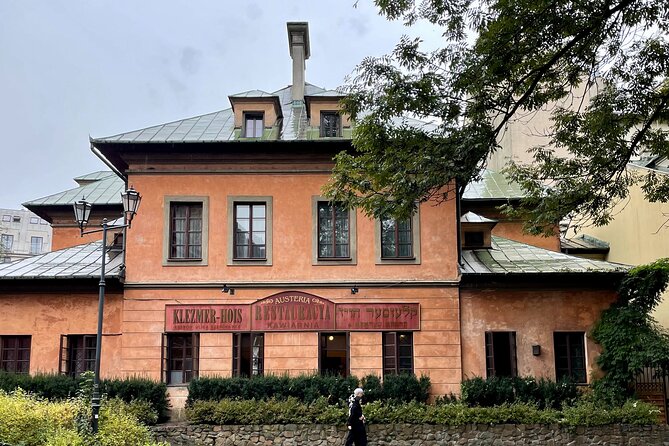
Next is Jewish Community Centre of Krakow, JCC Krakow. The narration covers how it unites the community and notes that it was founded by the current King of England. It’s a quick stop, but it shifts the emphasis toward community life.
That matters because the Jewish Quarter is not only a memorial corridor. It’s a place where culture and community continue. Audio tours sometimes over-focus on tragedy. This one tries to balance that with present-day community context.
Szeroka Street and the Mikveh idea, where daily life becomes visible
Then you move along Szeroka Street, with audio guiding you through what you might see connected to Jewish life. The narration mentions the mikveh and the synagogues, and it links what you are seeing to history in a practical, street-level way.
This stop tends to work well because it’s both straightforward and expansive. You’ll have enough time to look around, and the audio helps you connect patterns like building locations and street layout to the people who used them.
Wear comfortable shoes here. Even though the individual stops are short, the walk adds up when you are paying attention to the story.
Old Synagogue and the fortress-synagogue idea, rebuilt in 1570
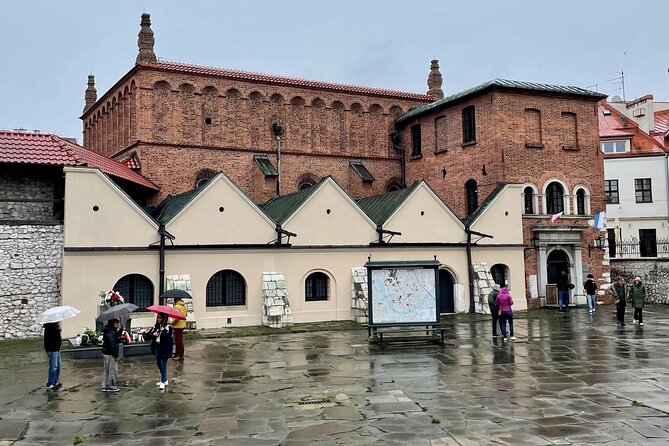
Another major moment is the Old Synagogue area. The audio explains that it was rebuilt in 1570 by the Italian architect Mateo Gucci (not the fashion icon, despite the name). You’ll also hear that it is a rare surviving example of a Polish fortress synagogue, with built-in “sunken” history that the narration helps you notice.
This is where the tour’s audio production style helps. The story is layered, and the soundtrack and sound effects are used to keep your attention while the narration points out what you might otherwise miss at street level.
If you want to understand why certain buildings look the way they do, this is one of the best value stops. It gives you a mental picture, and that makes the physical city clearer.
Jan Karski statue, the spy who took enormous risks
The route includes the Statue of Jan Karski. You’ll hear about the spy who risked his life to gather information about Nazi actions.
This segment is brief, but it does something important: it highlights how information and testimony mattered. It also complements the Ghetto and Quarter story, because it extends the idea of resistance beyond only what happened locally.
If you are someone who likes individual names tied to larger events, you’ll appreciate this pause.
A final stop at the Galicia Jewish Museum, bookstore plus mural
The tour ends at the Galicia Jewish Museum at Dajwór 18, 31-052 Kraków. The audio points out that after you explore the Ghetto and Jewish Quarter, you’ll finish here, at a bookstore and museum with an amazing mural.
This closing location is a smart “landing.” You don’t just walk away once you’ve hit the last sound cue. You can stay and browse, then decide whether you want more at your own pace.
You also get the benefit of the tour continuing after you walk: after the on-location portion, you can listen to the virtual tour anytime.
Price and value: why $9.99 can work so well for this part of Kraków
At $9.99 per person, this is priced like a budget-friendly add-on, but it can feel like a full guided experience because it’s designed for repeat use. The tour runs about 1 hour 10 minutes to 2 hours depending on pace, and it has mobile ticket and step-by-step GPS.
Here’s how I think about value: for this kind of history, a human guide can be great. But an audio route can also be excellent when you want privacy, control, and the ability to stop and re-listen. With this tour being go anytime and not expiring, you can do it in the morning, at night, or on a second pass when your brain is ready for more.
Also, the stops are mostly outside. That means your money isn’t tied up in entrance fees you might not use. The tour explicitly does not include entrance tickets, food, or drinks, and it doesn’t include a human guide. In return, you get a clear route and professionally produced narration with music and sound effects.
And based on feedback tied to real use, the experience is easy to operate once you’re set up. One thing to keep in mind is that any app-based tour can have an occasional glitch. Your best move is to download, test your audio, and make sure your phone battery is healthy before you start walking.
Who should book this audio walk
This works best if you want:
- A self-paced way to learn the Ghetto and Jewish Quarter story on foot
- GPS help so you do not have to constantly check maps
- Short outdoor listening stops instead of ticket lines
- The option to repeat it because you’ll likely want to re-walk segments
It’s less ideal if you need a live Q&A, or if your phone or data connection tends to be unreliable. Also, because the subject matter is heavy, you might prefer headphones and a calm pace, so you can control how much you take in at once.
Should you book this Kraków Jewish Ghetto and Quarter audio tour?
If you want an organized route through the most important sites without spending extra on entrance fees or waiting for a group, I think this is a strong pick. At $9.99, the combination of GPS guidance, professionally produced narration, and the ability to go anytime and listen again makes it easy to justify.
I would book it if you like learning in motion, and if you’re comfortable using your phone to navigate. I’d hesitate only if you know your device struggles with apps or if you strongly prefer a person to answer questions in real time.
If that matches you, you’ll finish with a much clearer sense of how the Ghetto, murals, bridges, streets, and public memory connect.
FAQ
How long is the Krakow Jewish Ghetto and Quarter audio guided walking tour?
It takes about 1 hour 10 minutes to 2 hours (approx.), depending on your pace and how long you spend listening at each stop.
Where does the tour start and end?
It starts at Plac Bohaterów Getta, Kraków, Poland and ends at Galicia Jewish Museum, Dajwór 18, 31-052 Kraków, Poland.
Is there a human guide during the tour?
No. This is a smartphone guided GPS walking tour. There is no human guide, and it is narrated through the app.
Can I take the tour at any time, and does it expire?
Yes. You can go anytime, it’s all outside, and it does not expire, so you can repeat it. After the on-location walk, you can also access the virtual tour anytime.
Are entrance fees included for museums or synagogues?
No. The tour does not include entrance fees. Many key stops are viewed from outside, and the experience is designed to stay outdoors.
What is the cancellation policy?
You can cancel for a full refund if you cancel at least 24 hours in advance. If you cancel less than 24 hours before the experience start time, the amount paid is not refunded.
Fresh Krakow reviews
- Krakow Skip The Line Wawel Castle & Old Town Guided Tour★ 5.0 · 3 reviews
- Krakow Zakopane Cable Car Vodka Cheese and Hot Springs Tour★ 3.5 · 3 reviews
- Krakow: Zakopane and Thermal Pools Tour with Hotel Pickup★ 5.0 · 3 reviews
- Museo Czartorisky : Visita in Lingua Italiana salta fila…★ 3.5 · 3 reviews
- Half-Day John Paul II Route Tour from Krakow★ 5.0 · 3 reviews
- Krakow: John Paul II Home & Black Madonna Sanctuary – Guided Tour★ 5.0 · 3 reviews
- 1-Hour Tour to Krakow’s Old Town by Electric Golf Cart★ 5.0 · 3 reviews
- Auschwitz and Birkenau WITHOUT GUIDE private transport from Kraków★ 5.0 · 3 reviews
Jewish Heritage Tours, compared.
Bike Tour of Old Town, Jewish Quarter and the Ghetto
Read our review →
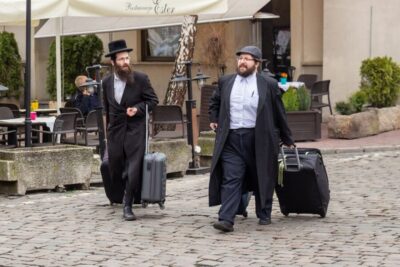
Kazimierz, Schindler’s Factory & Ghetto Guided Tour
Read our review →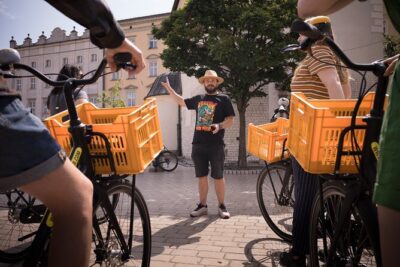
Full Bike Tour – the Old Town, Jewish Qtr & the Ghetto NEW BIKES
Read our review →
Warsaw Ghetto Private Walking Tour with Hotel Pickup
Read our review →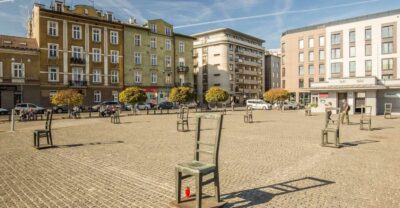
Browse the lists this tour appears in