
Reviewed · WALKING TOURS
Walk through the Warsaw Old and New Town: like Phoenix from the ashes
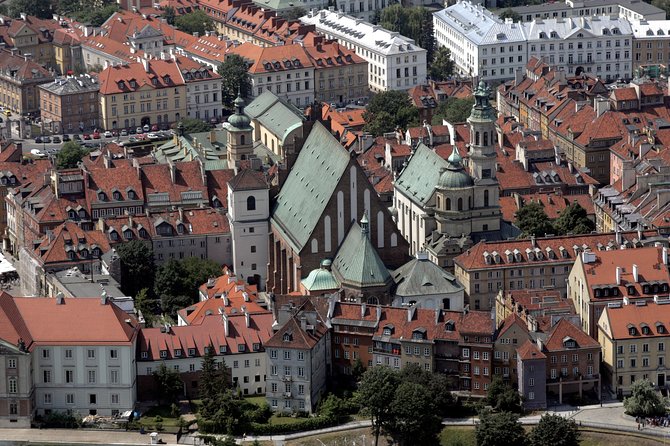
Warsaw can feel like a city that had to rebuild its own memory. This Old and New Town walk is interesting because you see how the city’s identity took shape through churches, royal links, WWII scars, and a rebuilt Old Town you can actually stand inside of. I like the way the route mixes big-photo landmarks with human stories, especially around Chopin and the Warsaw Uprising.
I also like the pace: about 2 hours with frequent stops, so you get narration without feeling like you’re sprinting between sights. One possible drawback is language nuance, because the tour guide is listed as German-speaking while the experience is offered in English, so you should confirm that your group will be comfortable with the language used for explanations.
Key highlights you’ll feel on the walk
- Chopin’s heart at Holy Cross Church, tied directly to the personal story the guide tells
- UNESCO Old Town at Castle Square, including how the reconstruction was financed and the role of a Venetian painter
- WWII through-lines in the Archcathedral Basilica of St John the Baptist, described as having war front activity run through it
- Marie Curie’s birthplace at the Muzeum Marii Sklodowskiej-Curie, with admission not included in the tour price
- Practical view stops like Gnojna Góra for a quick look toward the Vistula River
- A focused ending at the Field Cathedral of the Polish Army and the Warsaw Uprising monument
From Copernicus to Castle Square, you’re walking a Warsaw timeline
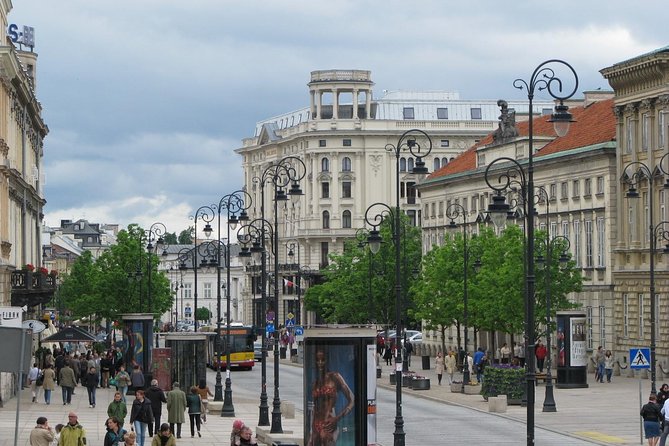
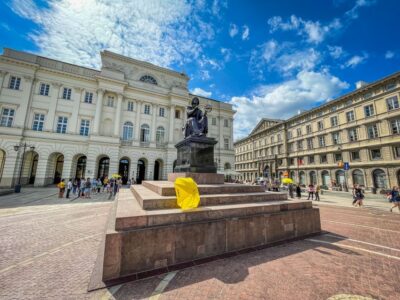
This tour starts at the Nicolaus Copernicus Monument in Krakowskie Przedmieście, where you meet your guide holding a PolinTours sign. From there, you move in a steady line through places that help explain Warsaw’s layered identity: a city that has royal ambitions, modern state power, and the heavy, very visible weight of WWII.
The format is a guided city walk, sold as a licensed tour with tax included. It’s designed around a compact route where most sights are free to enter, so you spend your money on the experience, not on surprise ticket fees.
Timing matters here. You’ll spend roughly 15 minutes at Castle Square, then move on through several shorter stops. That rhythm works well if you like being out in the streets, listening, and keeping your feet moving rather than doing a museum-heavy day.
More Walking Tours in Warsaw
- Warsaw: Old Town Highlights Walking Tour in English
★ 4.7 · 1,516 reviews - Warsaw: Old Town Guided Walking Tour
★ 4.9 · 599 reviews - Half-Day Polish Food Walking Tour with Guide and Dinner
★ 4.5 · 381 reviews
Price and value: $72.87 for a guided history walk that stays mostly outdoors
At $72.87 per person for about two hours, the value comes from what’s included: a licensed city tour and tax. You’re also getting a mobile ticket, plus group discounts. That can be a good deal if you book early or travel with others.
What’s not included is also clear, and that’s a big part of the value equation. There are no snacks included, and transport is not included. Admissions are not included either, though most stops in the route are marked as free. The one major paid admission mentioned is the Marie Curie museum, so you can plan for that optional extra cost.
If you’re trying to keep a Warsaw day simple, this tour is practical. It gives you a structured overview without requiring you to buy multiple tickets. And if your group is small, you may get a more personal, one-on-one feel, which can make the stories land better.
How the walk is set up, and what to expect from the guide
You’ll be picked up from the Nicolaus Copernicus Monument with the PolinTours sign. The guide is listed as German-speaking. The experience itself is offered in English, so for the smoothest day, I’d treat this as a point to confirm at booking. Either way, the walking plan is straightforward and the narration is the main product.
The group format is private in the sense that only your group participates. That matters because it affects how long questions take and whether you can slow down at tricky corners. In a place like Warsaw, small pace changes help, since many of these stops are about the meaning of a site, not just the postcard view.
Also note the tour is near public transportation and service animals are allowed. Most travelers can participate, which usually means it’s not overly long on strict stairs or remote countryside segments. Still, you are walking through Old and New Town streets, so wear shoes that can handle cobbles and uneven sidewalks.
Stop by stop: what each place adds to the story
Another way through a Warsaw day:
- Warsaw: Chopin Concert in the Old Town
★ 4.8 · 2,287 reviews - Warsaw: Traditional Galar Cruise on The Vistula River
★ 4.6 · 1,640 reviews - Warsaw Concert: Chopin – Painted by Candlelights with Wine
★ 4.8 · 1,442 reviews - Warsaw: City Sightseeing Hop-On Hop-Off Bus Tour
★ 3.6 · 1,415 reviews
1) Krakowskie Przedmiescie, the official-meets-historic opening
Your first stop is Krakowskie Przedmiescie, where the guide meets you near the Copernicus Monument. This start matters because it gives you a “street lens” right away. You’re not only being told history, you’re being shown how the city’s grand boulevards and formal spaces sit alongside the more dramatic WWII-era memory.
The German-speaking guide begins the thread that carries through the entire walk, tying locations to people and turning points.
2) Holy Cross Church: where Chopin’s story gets personal
Next is the Holy Cross Church (Kosciol Swietego Krzyza). The guide brings you close to the life story of Frèderic Chopin and points you to the church where his heart rests.
This is one of those stops that feels quietly powerful because it turns a famous name into something physical and specific. Even if you’re not a deep classical music person, hearing the connection explained in place helps you remember why Chopin matters to Warsaw.
Also, the stop is short and marked as free, so you can enjoy the atmosphere without feeling trapped in a long visit.
3) University of Warsaw: the oldest part of the institution
At the University of Warsaw (Uniwersytet Warszawski), you look at the oldest part of the university. It’s not presented as a full campus tour. Instead, it’s a quick, targeted look that gives Warsaw an academic backbone, showing that the city’s story is not only monuments and battles.
This short stop works well because it prevents the walk from becoming one long WWII-only narrative.
4) Tomb of the Unknown Soldier: Saxon kings, then soldier memory
The route pauses at the Grob Nieznanego Zolnierza, the Tomb of the Unknown Soldier. The guide adds more than the idea of anonymous sacrifice. You also learn about the Saxon kings’ estate in Poland.
This combination is useful. It reminds you that memorial culture sits next to political and royal power in Warsaw. The city doesn’t separate eras into clean boxes, and this stop shows that.
5) Palac Prezydencki: power, ceremony, and an unusual past
At the Presidential Palace (Palac Prezydencki), you admire the seat of the Polish President. The guide also explains its unprecedented history.
Even if you can’t linger long, you get a sense of how government, public space, and national identity intersect. It’s a reminder that Warsaw is a working capital, not just an open-air museum.
6) Castle Square (Plac Zamkowy): UNESCO Old Town and the reconstructed city
Then you reach Castle Square, Plac Zamkowy. This is the heart of the walk. The guide frames Warsaw’s Old Town as a UNESCO World Heritage site and calls it the youngest Old Town in the world. That phrasing is meant to make you pay attention.
You’ll learn about the unparalleled reconstruction of the Old Town, including how the reconstruction was financed and the role of a Venetian painter. And from this same area, you hear about the first democratic constitution in Europe.
When I’m walking through a reconstructed historic center, I always ask myself a practical question: is it authentic, or just staged? This stop gives you a way to think beyond looks. You’re not only admiring stone walls. You’re learning the logic, effort, and money behind what you see now, and that changes how you interpret every street corner.
You’ll also see the Royal Castle from Castle Square and connect it to the broader political narrative you’ve been hearing all morning.
7) Archcathedral Basilica of St John the Baptist: WWII lines that ran through a church
Next is the Archcathedral Basilica of St John the Baptist. This stop is special because you visit the church described as the only church in Europe through which the war front ran during the Second World War. You learn about the heroic struggle of Poles in the Warsaw Uprising and the role of the Russian army.
This is heavy content, but it’s delivered as place-based history. Standing where the guide says the front line activity passed through makes the story feel less like a textbook and more like a lived event.
The stop is about 10 minutes and free, which helps. You get the essential context without dragging the emotional weight out longer than it should go.
8) Gnojna Góra: a short pause for the Vistula
At Gnojna Góra, you get a look at the Vistula River. It’s brief, but it matters. Warsaw is a city built on water and trade routes, and a quick view gives you scale.
This stop is useful if the earlier WWII and political stops start to stack up in your head. A glance toward the river helps you reset your mental map of where you are.
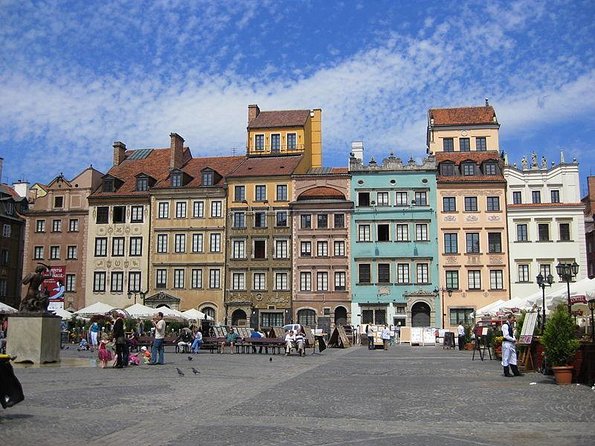
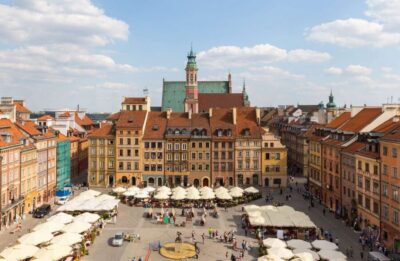
9) Rynek Starego Miasta: legends and real street feeling
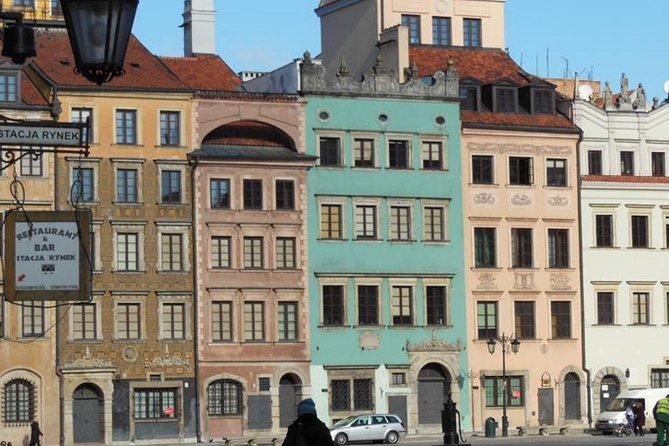
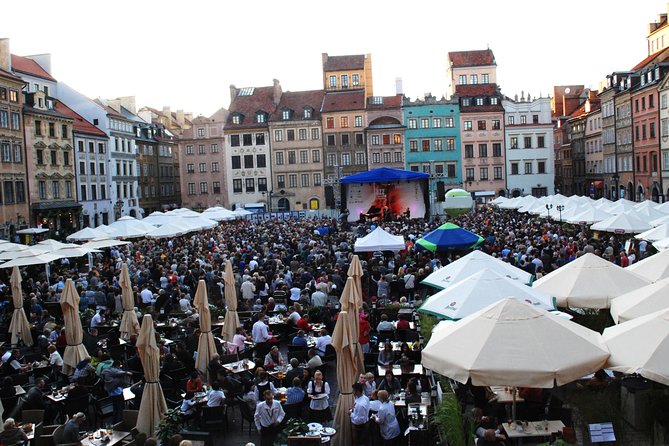
Rynek Starego Miasta is the market square in the Old Town. Here you walk through picturesque streets and see famous corners and landmarks. The guide also shares legends and authentic stories tied to the area.
This is where the tour becomes more “walking experience” than “lecture.” You get to feel the Old Town’s geometry: where sightlines pull you, where corners funnel people, and where the market square becomes a natural place for storytelling.
Crossing into the New Town, then Marie Curie’s birthplace
After you pass through the city gate, you enter the New Town side of the route. This shift is smart because it prevents the day from freezing in one era. Old Town gives you the reconstruction focus. New Town gives you a different kind of pride: science and modern cultural identity.
At the Muzeum Marii Sklodowskiej-Curie, you explore the birthplace of Marie Curie. The key detail for your planning is that admission is not included. So if you want this part of the experience, you should expect to pay for entry separately.
In practical terms, this is the best time to decide whether you want museum time. If you’re short on energy, you might treat it as a quick interior visit. If you love science stories, you’ll probably enjoy slowing down and letting the place do its job.
Ending at the Field Cathedral and the Warsaw Uprising monument
The tour concludes at the Field Cathedral of the Polish Army and ends at the Warsaw Uprising monument. You’ll stop at the monument of the Warsaw Uprising as the final anchor point of the walk.
This is a strong ending because it ties your earlier sites back into one theme: what the city remembers and what it honors. Even if you don’t know every detail before you arrive, you leave with a clear sense of the Uprising as the emotional thread connecting multiple locations you visited.
It also helps that the end location is a meaningful public space. You finish the tour and can decide how to keep your day going based on your mood, whether that’s more walking, a meal, or just sitting for a while and letting the stories settle.
Who should book this Warsaw Old and New Town walk
I think this tour is a good fit if you want an organized overview that mixes architecture, personal stories, and WWII memory in a walkable format. It’s also ideal if you like paying attention to details like reconstruction financing and the specific roles people played, not just dates and names.
You might consider skipping it if you only want pure sightseeing with minimal emotional weight. The route includes WWII content tied to real sites, and it’s not a lighthearted stroll the whole way through.
It’s also a solid choice for people who prefer guided structure. Most of the stops are free to access, so you get guidance without constantly managing ticket queues for every location.
Should you book this tour
Yes, I’d book it if you want a compact, mostly free, guided walk that gives you a real framework for Warsaw. The value is in the combination: Chopin at Holy Cross Church, UNESCO-era reconstruction at Castle Square, and the WWII-linked storytelling at the Archcathedral Basilica of St John the Baptist, capped with an ending at the Field Cathedral and the Warsaw Uprising monument.
Two practical tips before you decide. First, confirm language comfort, since the guide is listed as German-speaking while the tour is offered in English. Second, plan for the Marie Curie museum admission if you want to go inside, since it’s not included.
If those fit your trip style, this is a smart use of about two hours in Warsaw.
FAQ
How long is the Warsaw Old and New Town walk?
It runs for about 2 hours.
Where does the tour start?
It starts at the Nicolaus Copernicus Monument on Krakowskie Przedmieście, 00-333 Warszawa, Poland.
Where does the tour end?
It ends at the Warsaw Uprising Monument at plac Krasińskich, 00-263 Warszawa, Poland.
What is the price per person?
The price is $72.87 per person.
What is included in the tour price?
Included is a licensed city tour and tax.
What is not included?
Not included are snacks, transport, and admissions.
Are there admission tickets needed for the stops?
The route lists admission ticket free for most stops, but the Marie Curie museum has admission not included.
Is the tour offered in English?
Yes, the experience is offered in English.
Is this a private tour?
Yes, it is listed as a private tour or activity, so only your group participates.
Can I bring a service animal?
Yes, service animals are allowed.
Fresh Warsaw reviews
- Warsaw: Wolf’s Lair & Swieta Lipka Small-Group Tour + Lunch★ 5.0 · 3 reviews
- World War II Warsaw Old Town, Military Cemetery Walking Tour★ 4.7 · 3 reviews
- Warsaw: Old Town Walking Tour, Hidden Gems & Hot Chocolate★ 4.3 · 3 reviews
- Warsaw: Explore the Vistula on Its Longest Speedboat Route★ 4.6 · 3 reviews
- 5-hour: Royal Castle, Old Town and POLIN Museum/inc.Pick-up/★ 5.0 · 3 reviews
- Museum of Modern Art in Warsaw★ 5.0 · 3 reviews
- Majdanek – German camp from II World War – Private Tour – 1 DAY TRIP FROM WARSAW★ 5.0 · 3 reviews
- Warsaw Outdoor Paintball with Transfers (all year round)★ 5.0 · 3 reviews
Walking Tours, compared.
Gdańsk City Sights & History Guided Walking Tour in English
Read our review →
Browse the lists this tour appears in